Thursday, 9 June 2022


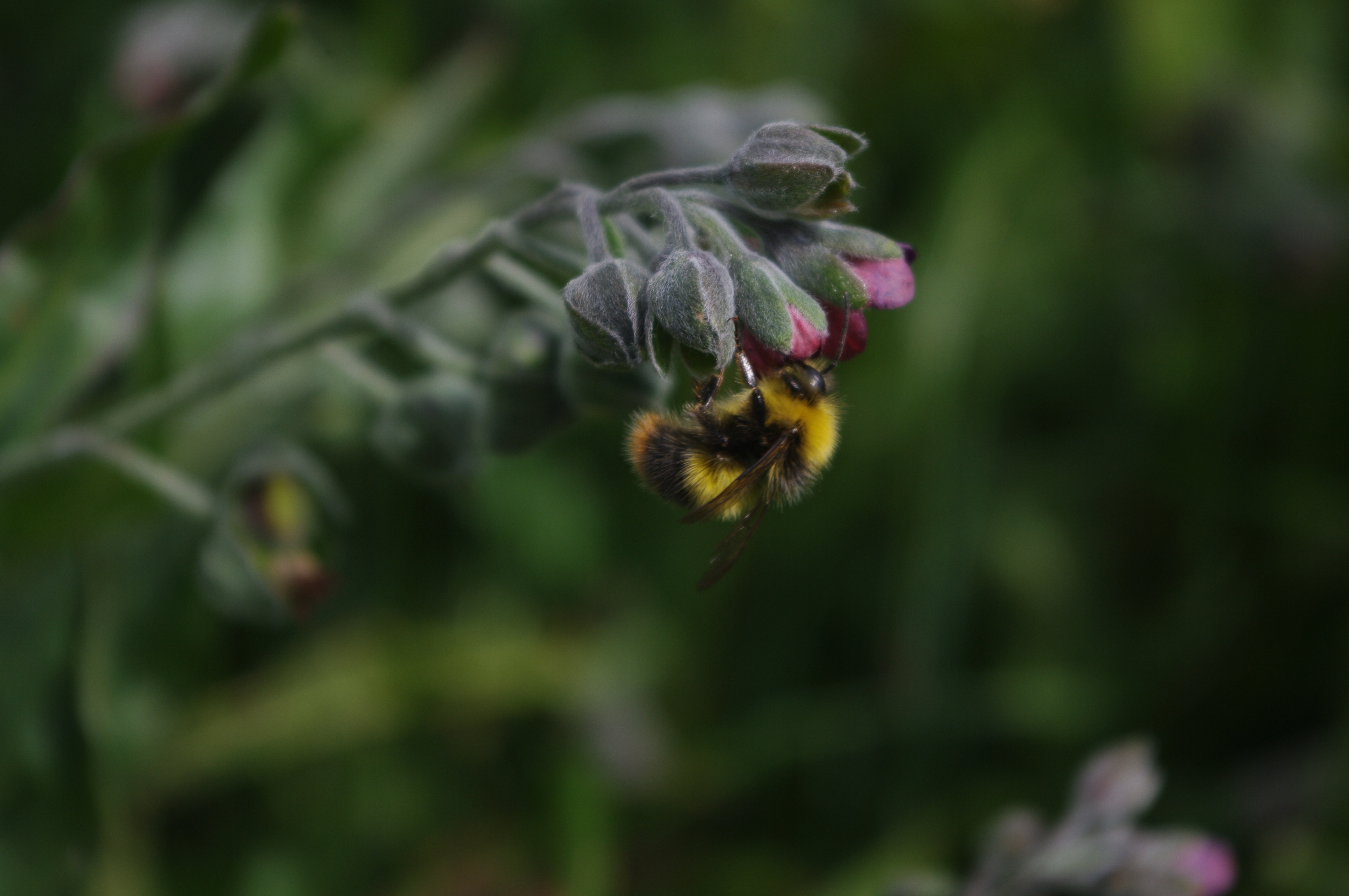
 Here are some more wildflowers I spotted during my walk via Knocking Hoe, the Pegsdon Hills and the Barton Hills on Saturday. As I noted there were some little beauties nestling low among the grasses but I saw a number of taller species too. I don't think any of these have featured in the diary before. There were a good many Hound's-Tongue (Cynoglossum officinale) much favoured by bumblebees.


 Just beyond the Pegsdon Hills where I joined the Icknield Way there is a pocket of woodland. Stopping for a moment in the semi-gloom I noticed a profusion of White Helleborine (Cephalanthera damasonium).     
 Always a delight to encounter Orchids. I assumed they were yet to come into full flower but I gather that the flowers rarely open. They do attract insects but it is thought they are largely self-pollinating.
 Something of a rarity -largely restricted to southern England on this isle- but can be found as far north as Sweden and as far east as Asia.


 About half way between the Pegsdon and Barton hills the Icknield Way becomes a tarmac lane rather than a track. Some say it is the oldest route in England still in continuous use. In stretches it has become sections of both minor and major roads yet in parts is no more than a footpath.
 At this point a crossroads is formed with the road that connects the villages of Lilley and Hexton. The verges here are fabulous for wildflowers. I assume they represent a survival from the surrounding fields which are now intensively farmed arable monocultures.
 I saw something yellow glinting in a ditch which proved to be Yellow Loosestrife (Lysimachia vulgaris). I have not seen this moisture-loving species anywhere else in the area which is one of the drier parts of the country. Perhaps this patch is the one and only?
 John Shipton of Shipton Bulbs once published a blog called "A guide to five star ditches". Accordingly I award this ditch five stars.   


 On Barton Hills I came across this lovely display. Which begs the question: what is it? I think it might be Greater Burnet-Saxifrage (Pimpinella Major). 
 Anyway all in all a good walk for wildflowers. I'll aim to repeat it in month or so when the flowers of high summer should be reaching their peak.

Wednesday, 8 June 2022


 Urban sprawl in reverse. Nature advancing on the city rather than the other way round. The pavement is wide so it's not creating an obstacle.
 Years ago I read a novel called 'After London' written by Richard Jefferies in 1885. The story is prototype science fiction beginning with a description of the metropolis being reclaimed by nature after some unspecified apocalypse. 
 Jefferies was a prolific author of essays on the countryside and natural history. Botanically speaking the succession he describes from city to wilderness seems very plausible. If humans disappeared it wouldn't take long... 

Monday, 6 June 2022


 I've noted in several entries that Echium pininana has been naturalising in warmer parts of the UK. It's one of the "giant" Echiums found on the Canary Islands. I grew another species which was probably E. wildpretii in my front garden several years ago, also the subject of several entries.
 E. pininana is sometimes called Tree Echium due to its height. In fact it's a triennial and not a tree but today in St. James's Park in central London I saw an Echium that is indeed woody and clearly quite long lived. I think it's probably E. candicans. This name seems to be synonymous with E. fastuosum and refers to a shrub species which is sometimes called 'The Pride of Madeira'.
 In fact both the Latin and common names of the Echiums of the Canaries appear to be rather fluid so I'm happy to be corrected by any Echium experts out there. I assume they are an example of how species can evolve which are distinctively different yet very closely related due to their proximity to each other in a geographically isolated location.
 This single specimen of bushy Echium was presumably planted there though elsewhere in the park E. pininana is multiplying quite rapidly by self-seeding. 

Sunday, 5 June 2022


 The aforementioned nature reserves [last entry] are great places to see wildflowers. In high summer some of the slopes are intensely coloured by flowers in bloom. Yesterday it was more a case of spotting little beauties growing among the grasses; for example these Common Rockrose (Hellianthemum nummularium) on the Barton Hills. 

Saturday, 4 June 2022


 One of my favourite walks takes in Knocking Hoe and the Pegsdon Hills along the border of Hertfordshire and Bedfordshire. Today I extended my usual route and kept going till I reached the Barton Hills (above). 
 All three are designated as a National Nature Reserve and Site of Special Scientific Interest. Too steep to be ploughed they survived the industrialisation of agriculture and retain the flora and fauna of undulating chalk grassland. 

Friday, 3 June 2022


 Pollinators part five. The flowers of Geranium x oxonianum are intricately veined shades of salmon pink. As noted in my previous entry they are prolific in the garden at the moment. That's great for honey bees, by which I mean Apis mellifera.


 This is the bee we get our honey and beeswax from from. Apis mellifera was domesticated thousands of years ago- it's a moot point whether it still exists as a wild species. Bees are kept the world over and urban beekeeping is widespread. I'm aware of at least half a dozen hives within a mile of the garden.


 Bumblebees will mix and match flowers of different species as they forage but honey bees concentrate on working a single species flowering en masse. So this pink haze of G. x oxonianum is perfect for them. 

Thursday, 2 June 2022


 The garden shimmers with the pink flowers of Geranium x oxonianum at this time of year. The RHS Plant Finder describes it as "a fertile and variable hybrid between G. endressii and G. versicolor." I've taken advantage of its spreading habit to fill the garden with colour.