Shipton's bare root plants are tough. Check out this Primrose, one of five delivered in a protecting clod of mud around the root ball. You can tell this has been grown outdoors in Wales. Quite different to the dainty little things sold in garden centres.
A diary of back garden botany, urban ecology, rural rambles and field trips to the middle of nowhere...
Sunday, 29 September 2024
Thursday, 26 September 2024
A box full of treasures in the form of a delivery from Shipton Bulbs. Note that some of the bulbs come in brown paper bags and some in plastic bags with a little compost to keep them moist.
The bulb trade operates for the most part on the sale of dry bulbs which can be taken from the ground, stored, distributed and sat awhile in shops awaiting sale. Some species are indeed amenable to this. Their natural habit and habitat is to be spring flowering then go dormant in the summer when the soil is drier. A bulb is a storage organ for nutrients so may be able to dry out somewhat during dormancy and revive on planting in the autumn.
Case in point I ordered 20 "Tommies" (i.e. Crocus tommasinanus) which are usually fine as dry bulbs. Even so it's better to buy dry bulbs early in autumn when they will have been lifted fairly recently. Certain bulbs e.g. Snowdrops don't like to dry out and will quite possibly be dead rather than dormant if not fresh. Beware of end of season garden centre sales!
For obvious reasons the bulk bulb growers tend to concentrate on species and cultivars that are most amenable to mass production and mass distribution. Like buying apples from a supermarket you get the ones that are easiest to commodify not necessarily the best to buy.
By contrast Shipton specialise in native bulbs grown on their smallholding in Wales. My impression is that our wild species generally need to be moist throughout their life cycle e.g the Ramsons in this order.
NB The term 'bulbs' is a convenience which often as not includes rhizomes, tubers and coums e.g. Solomon's Seal which arrives as gnarly sections of rhizome rather than bulbous.
I also bought a handsome selection of Shipton's bare root plants. I've noted before they are about as close as you can get to actual wild things though cultivated. As mentioned a few days ago bare root seems to be enjoying a revival. On the whole I find it a better way to obtain well established, hardy specimens.
Tuesday, 24 September 2024
Sunday, 22 September 2024
Autumn and spring are the optimum time for planting though garden centres do most of their business in the summer months. Plants are best established when going into or coming out of dormancy. The soil is still warm in autumn or warming up in spring and there is (generally) plenty of moisture from the sky.
I do buy plants in pots but bare root is as good if not better because the roots aren't potbound. And the plants tend to be healthier and hardier from being grown in the ground as nature intended.
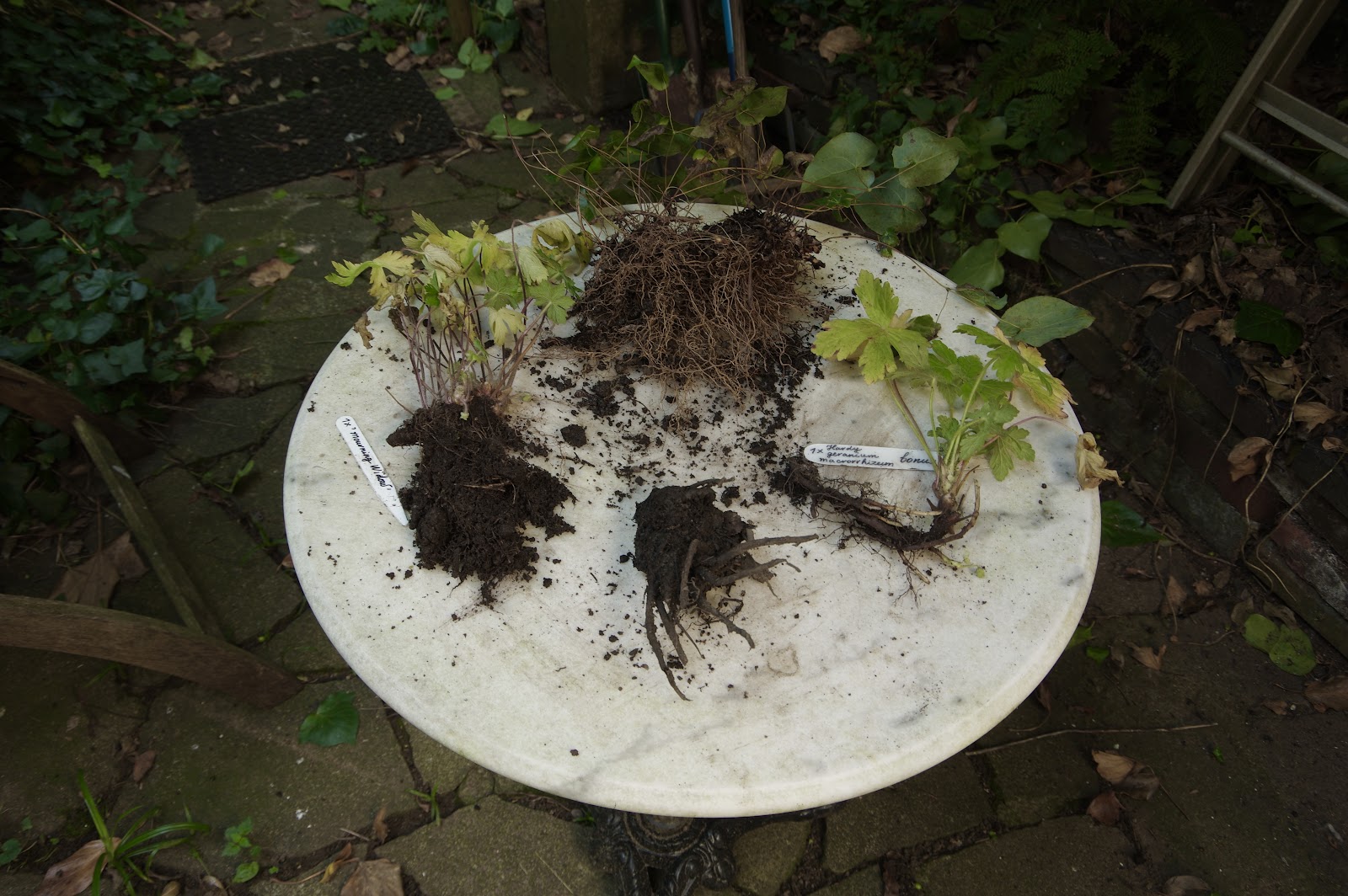
On the table at the top is an Epemedium. I was given several clumps from a patch that needed to be reduced. On the left and right Geranium phaeum and G. macrorhizum. I ordered three of the former and the latter was sent by the seller as a bonus. The earthy clump at the bottom is one of five Pulmonaria officinalis. The seller apologised for them being so muddy but from the mud they came and to the mud they will return! Actually it never occurred to me this rather dainty plant has such a rooty rootball.
Lifting plants from the soil and selling them bare root was the old fashioned way before growing in plastic pots became a thing. It's probably enjoying something of a revival among small scale propagators trading online to save costs on shipping and packaging (the many uses of a shoebox!).
Useful way of tracking down slightly obscure plants. For example various cultivars of Lungwort are easy to find in garden centres etc. but the wild form P. officinalis is hard to come by. Likewise numerous cultivars of Columbine are widely available but not the pink form of A. vulgare. Accordingly I ordered 6 which were described as 'plug plants'. Actually bare root is a better description; plug plants tend to be smaller and younger, not much larger than seedlings in some cases. Being uprooted for a day or two in transit is not a problem as long as there is some soil or compost and wrapping around the roots to keep them moist as seen here.
Friday, 20 September 2024
Devil's Bit Scabious (Succisa pratensis) is a wildflower of grassy places, but I see it in two distinctly different habitats. I come across it on chalky hillsides like the South Downs and the Pegsdon Hills where the soil is free draining. Then again I see it in flat marshy environs like Oughtonhead Common where the ground is boggy for much of the year.
Wildflowers have their niche and it is generally wet or dry but not both. I only find Devil's Bit on chalk that is sloping where the runoff of rainfall may serve to water it. Whereas a marsh like Oughtonhead is less saturated by the time Devil's Bit comes into flower. So perhaps it's soil type is the proverbial "moist but well-drained"?
Wednesday, 18 September 2024
Subscribe to:
Posts (Atom)