Sunday, 29 April 2018


 Lamiums are sometimes called deadnettles due to some of the 40 or so species having a resemblance to stinging nettles (without the sting). Above is the yellow flowered Lamium galeobdolon. The straight species has plain green leaves and is found in ancient woodlands; indeed its presence is generally an indicator that the woodland is ancient. There are also varieties with a frosty white variegation of the leaves (as above) which is a natural variation in Eastern Europe and Russia and sold under various names over here.
 Gardening books sometimes warn against planting these due to their invasive tendencies. I know several gardens (including here) where it has it has run to large patches but is this a problem? It does well in part shade and forms an excellent groundcover of attractive foliage all year round.
 In spring it throws up spiky clusters of yellow which are a magnet for bumblebees. They shoulder their way into the clam-like flowers forcing them open to feed on the nectar within.     

Friday, 27 April 2018


 Some back garden foraging. Nettle risotto with Ramsons (Allium ursinum) aka Wild Garlic in place of the clove variety and a flat bread (flour and water) with grated cheese garnished with a few leaves of Garlic Mustard and chopped Ramsons. Garlic Mustard is neither garlic nor mustard but has a faint taste of both. Ramsons have a taste somewhere between garlic and onion, particularly tasty raw with a bit of cheddar in my opinion.


 Speaking of Garlic Mustard (Alliaria petiolata) this self seeding biennial of shady spots is particularly abundant this year not only in the back garden but round about town and in the countryside.


 I've read that Garlic Mustard is a valuable food plant for the caterpillar of the Orange-tip Butterfly. I was in the garden musing on this and the fact that butterflies in general seemed to have declined markedly when I saw an Orange-tip on the flowers of the Garlic Mustard!
 I went to get my camera by which point it had turned its attentions to the flowers of the Honesty (Lunaria annua).


 Honesty is another self seeding biennial that is having a good year, I've been noticing it growing wild all over the place (like above on the allotments). Clearly something about the conditions has suited both species.
 Martin Crawford says in his book 'Creating a Forest Garden' that the leaves, flowers and tap roots of L. annua are edible though I can't say I've put that to the test.      

Thursday, 26 April 2018


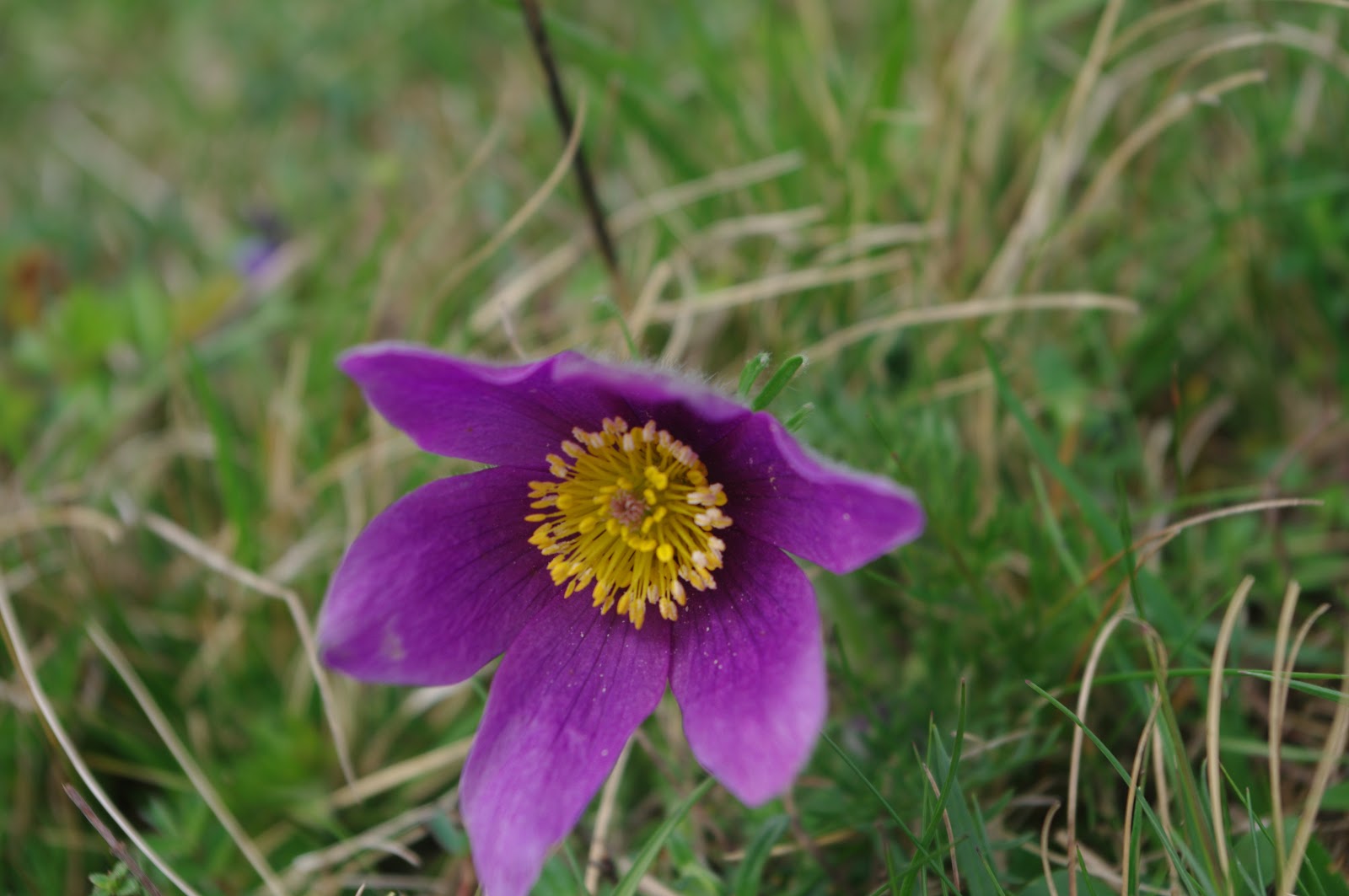
 I went in search of the Pasqueflower (Pulsatilla vulgaris) earlier in the week. A friend mentioned they were in flower on Therfield Heath near Royston. As the common name suggests they are associated with flowering round about Easter.
 Some wildflowers are generalists- for example there's no need to conserve Cow Parsley which grows everywhere. But others are specific to very particular habitats that have been much denuded by modern agriculture. Case in point the Pasqueflower which requires sloping chalk grassland grazed to a short sward. One of its few remaining sites in the wild is at Church Hill on the heath.


 Most of Therfield Heath is a golf course, possibly a good thing. You never hear of a golf course being built on. School playing fields yes and ancient woodlands but golf courses never. The rougher fringes of the greens are plentiful with Cowslips (Primula veris).


 Beyond the links is a small wood of tall mature Beech (Fagus sylvatica) and beyond that Church Hill which has long been noted for its colony of Pasqueflowers. Their survival was probably a fluke, the hill is too steep to be of any use for crops or golf and now is maintained as a nature reserve.
 Here the Pasqueflowers grow in drifts. Beautiful to see but hard to photograph. The sun shone and dimmed constantly as blustery clouds blew overhead. P. vulgaris is diminutive and shook back and forth as the wind raked across the hill though they were quite able to withstand the blasts.
 Appropriately Pulsatilla is a subgenus  of Anemone which are sometimes referred to as 'windflowers' (from the Greek. Anemone: "daughter of the wind").


Tuesday, 24 April 2018

Monday, 23 April 2018


 Dogs' teeth (dens-canis) is the curious name applied to the European Erythronium because the bulbs bear a resemblance to the tooth of a canine. Above is an American cultivar Erythronium Pagoda. The bulbs of American species have a similar appearance but this doesn't seem to have figured in the naming the plant.
 I planted a dozen or so of Pagoda in the shady "woodland" part of the garden and very nice they are too. In the back of my mind was the memory of seeing a streamside meadow near Crater Lake, Oregon last year dotted with hundreds of Erythroniums. I think these were E. grandiflorum and Pagoda seems like a close relative when I compare it to the ones I saw that day:


Saturday, 21 April 2018


 I grow several kinds of Comfrey in the garden. Symphytum orientale is just coming into flower now.


 Sometimes called White Comfrey the flowers are indeed pure white. It grows to several feet tall, expanding to form clumps and is something of a self seeder. It hails from Turkey I believe but has become quite widely naturalised. Rather graceful as Comfreys go in my opinion.


 Symphytum grandiflorum aka Creeping Comfrey is as the common name suggests a low growing groundcovering Comfrey. Actually I wouldn't say that the florum are all that grandi but they have a lovely creamy colour. This is the first of the species to flower from early spring onwards.


 Symphytum Hidcote is a cultivar whose origins seem to be somewhat obscure. The flowers have a pronounced bluish or pinkish tinge.
 It's also a good ground cover and S. grandiflorum is most likely one of its antecedents. Comfreys hybridize quite freely and there are a number of them developed by breeders over the years. All the above are good in part shade and dry soil which can be useful.


 Bees love all Comfreys. If you want bees in the spring garden: plant Comfrey.
 

Friday, 20 April 2018


 A bumper crop of spring flowers in the garden. We've had a typically damp spring now the sun is shining like summer has come. Result: rampant growth everywhere.


 Greater Stichwort is a plant of hedgerows. I'm happy to say a small plug of it has run wild and continues to expand.


 The pink/purple flowers of Honesty seed themselves around the garden. The blue forget-me-not like flowers behind are Green Alkanet which spreads vigorously.


 The graceful Narcissus Thalia is still in flower.


 As is the patch of Anemone blanda (which also comes in shades of blue but I prefer the white form).


 Red Campion, still a common wildflower in parts of the countryside and an attractive plant for the garden.


 Three-cornered Garlic is regarded as an invasive weed in parts of the UK. I'll write an entry on this topic at some point because quite a few of the plants I love are "invasive" and there are two sides to that coin.


 Garlic Mustard is a biennial which self seeds in shady spots around the garden. The leaves taste of garlic and mustard. I might add some to a salad later. NB Plants should only be eaten when absolutely certain what it is and if edible!


 Great Wood Rush. I bought some clumps of this from Shipton Bulbs and I cannot improve on their description: "tussocks of glossy long narrow leaves and thin stems of tiny chestnut-brown flowers, this makes a fine feature in a woodland area".


 Some people would say this is a weed. Some people have no poetry in their soul.