Wednesday, 16 April 2025


 Looking from Knocking Hoe towards Knocking Knoll on the horizon, thought to be the remains of a long barrow. Features and artefacts from the general area date from the Iron Age onwards. William Ransom undertook a dig of the Knoll in 1896 and found pieces of pottery believed to be Saxon. NB he it was who commissioned the country house known as Fairfield in Hitchin which is now home to Benslow Music School where I garden regularly.


 On the Hoe itself Pasque Flowers (Pulsatilla vulgaris) are starting to bloom. They flower around Eastertime -hence Pasque- though I think their peak is still a week or two away. Knocking Hoe is one of a handful of locations in the UK where they grow in significant numbers.
 The day was bright but very breezy. A sloping chalk hillside is their ideal habitat; trying to photograph Pasque Flowers between gusts is a familiar experience. The species used to be designated as Anemone pulsatilla which is apt. Anemos is the Greek word for wind and plants from that genus are commonly known as Windflowers.
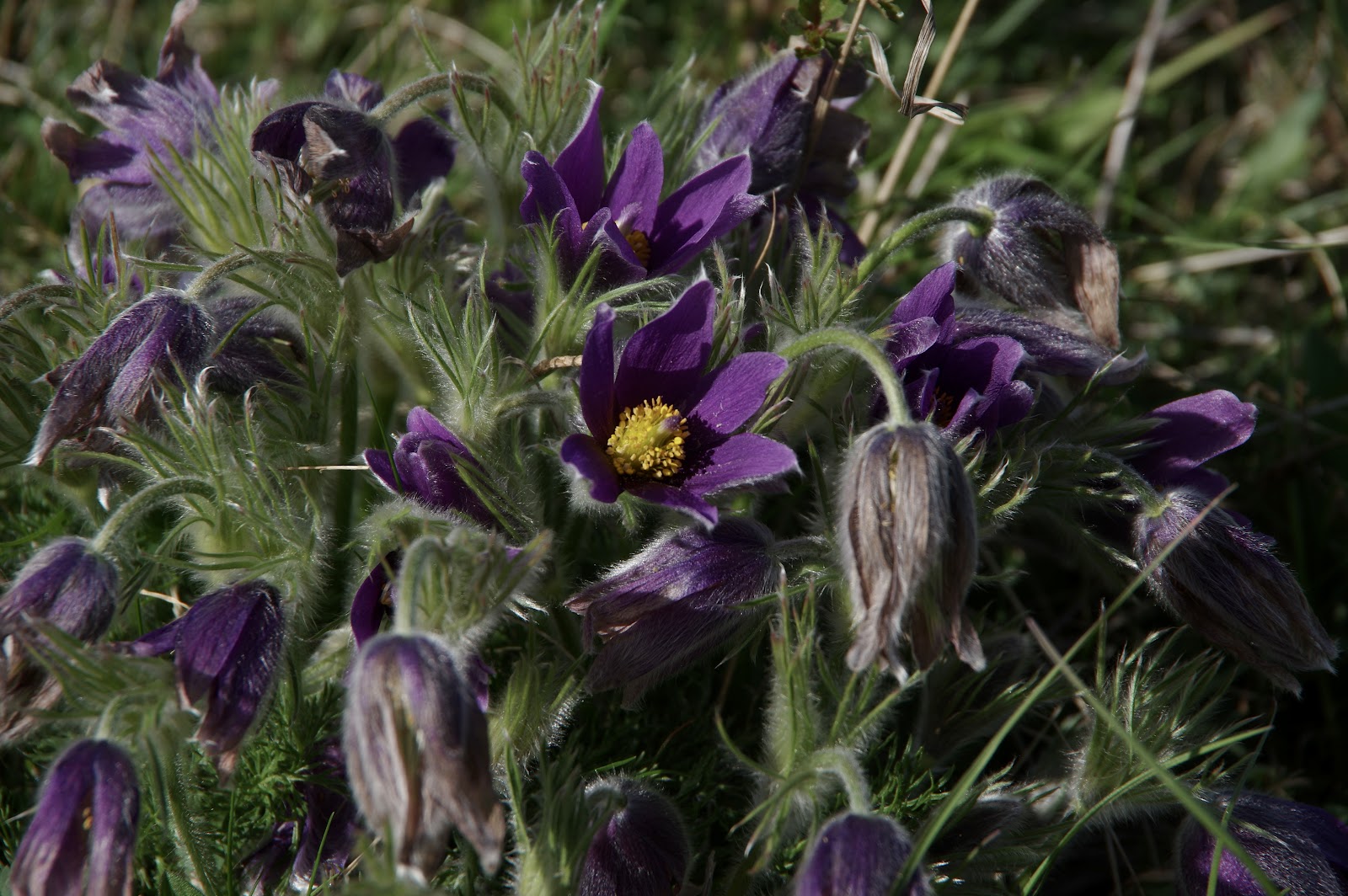


 Lore has it that Pasque Flowers only grow on ground where Danish blood was shed; Dane's Blood is another colloquial name. They are associated with a number of sites where barrows and earthworks are found. I would think the rational explanation is that these are habitats that have survived to this day by virtue of their history whereas others have been lost.
 Or perhaps this fragment of an ancient landscape was indeed soaked with the blood of Danes who fell in battle...  

Monday, 14 April 2025


 Cowslips (Primula veris) are in flower. In fact these are in Hitchin cemetery rather than the countryside beyond. Perhaps they were planted here but it seems reasonable to imagine that they were present in the locale when it became consecrated ground and have persisted. 
 Churchyards and cemeteries are grasslands of a sort and the mowing regime may favour certain species. I know that local conservation volunteers take an interest in the flora and fauna of Hitchin cemetery. Certain areas are clearly managed with that in mind.
 As I have noted before there is a fine display of Cowslips among the gravestones of All Saints church in St. Paul's Walden [see entry dated 3rd. May 2023]. Sheep are grazed there in winter so it seems a conscious effort is made to create the short sward that suits P. veris [see entry dated 25th. January 2025].  

Sunday, 13 April 2025

Saturday, 12 April 2025


 Ground Ivy (Glechoma hederacea). Not an Ivy but a member of the Mint family. Spreads vigorously by creeping stolons in sun or shade, town or country. Dainty aromatic leaves with tiny flowers much favoured by bees and butterflies. 

Friday, 11 April 2025


 Wayside weeds and wildflowers are flourishing in the warm spring. Here are two of my favourites growing in close proximity: Green Alkanet (Pentaglottis sempervirens) and White Deadnettle (Lamium album). Both are manna for bees.


Tuesday, 8 April 2025


 Travelling back and forth by train between London and Hertfordshire I observe the onset of spring across thirty miles of countryside. The aforementioned Cherry Plum and Blackthorn are much in evidence with Hawthorn to come. As noted they are frequently the remnants and relics of hedgerows. 
 Consider the vista above. Scenic in its way but basically one huge field that would have been a patchwork of fields divided by hedgerows and tracks. Something of a hedge still exists alongside the railway line hence the blossom. Not much for pollinators across this swathe of open country.
 In some locales more hedgerows have survived or at least pockets of shrubs and trees that were formerly part of a hedge. Happily these three species form thickets quite readily so can perpetuate themselves to some extent.
 The window of a train can be a good vantage to picture a disappeared landscape by observing the bursts of blossom dotted here and there.

Sunday, 6 April 2025


 The beehives at Benslow in their glade of blossom. The British landscape bursts with white blossom in the springtime.
 The first to flower is Cherry Plum (Prunus cerasifera) in early March [see entry dated 21st. March]. Later in the month Blackthorn (Prunus spinosa) shines brightly into April as seen above. The two species look very similar. A few weeks after that comes Hawthorne (Crataegus monogyna) sometimes called the Mayflower.
 All three were commonly used to form hedges between fields. Those we see in the landscape are often in surviving hedgerows or survivals of hedgerows that are gone. Left to their own devices they grow from large shrubs into small trees.