Thursday, 13 February 2025


 The Hellebore most commonly planted in gardens is Helleborus argutifolius, sometimes called the Corsican Hellebore or the Holly-Leaved Hellebore. Native to Corsica and Sardinia it is hardy in UK conditions. Easier to establish than H. foetidus which seems to flourish only on well drained chalky soils.
 Both species have green flowers (not many plants do) but the flowers of H. argutifolius are more open and bowl-like. Unlike the Stinking Hellebore its foliage has a serrated edge, hence argutifolius meaning sharp-toothed leaves.

Tuesday, 11 February 2025


 Pollinators can be seen foraging for pollen and nectar as soon as it becomes available to them- if the weather is mild enough. In fact this photo is from February a couple of years ago. We have become accustomed to warmer winters in the UK but not this year. Snowdrops are in flower as are Winter Aconites, Hellebores etc. but I have yet to see any pollinators on the wing, it's just too cold.
 The mean temperature for the UK in January was 3°C which is 0.9°C less than the LTA (long term average) 1990-2020. Actually I rate it as one if not the coldest spells during that period where southern England is concerned. There have been frosts night after night and temperatures not much above freezing day after day. However this would have been considered fairly typical during the previous LTA 1961-1990.
 Mysteriously the Met Office has said that January was the fifth sunniest on record. Not in Hertfordshire or London; perhaps other parts of the country bagged all the sunshine?? 

Sunday, 9 February 2025


 The Stinking Hellebore (Helleborus foetidus) can be considered both a native wildflower and a garden escape.
 For example I saw it recently around the margins of Hill End Chalk Pit in Hertfordshire. This corresponds to its natural habitat: scrubby, unimproved chalk grassland. The area is far enough away from human habitation that it's reasonable to suppose this might be the survival of a wild population.
 Then again it's one of those species that's considered "garden worthy" and has long been propagated for that purpose. It self-seeds readily where it finds the chalky conditions it favours. Gardens are more than likely the source of H. foetidus in the countryside near conurbations. 
 I often spot the bright green flowers alongside railway lines. No doubt the seeds have been carried in the wake of trains and found a suitable habitat in the limestone clinker. This is a wild species that was domesticated then "re-wilded" itself. So the distinction between 'native' and 'naturalised' is moot.
 The one seen above is in the grounds of the music school where Stinking Hellebores pop up all over the place. Probably planted as ornamentals at some point in the garden's history and multiplied of their own accord. Or perhaps they were here already on this chalk hillside when the house was built in 1859? 

Thursday, 6 February 2025


 Travelling into London this morning: freezing fog and frosty fields. This is the coldest winter we have had for a long time despite January being declared the warmest on record globally.

Wednesday, 5 February 2025


 Three is the magic number for compost bins. This facilitates a three year rotation. One filling up with new cuttings, clippings etc. One full and in the process of composting. One well rotted with lovely loamy compost.
 As it happens the music school has two, both enormous. One is almost full of composting matter and the other almost empty of actual compost. Never mind, two is better than one or none. And the fungi, bacteria and invertebrates are hard at work...        

Monday, 3 February 2025


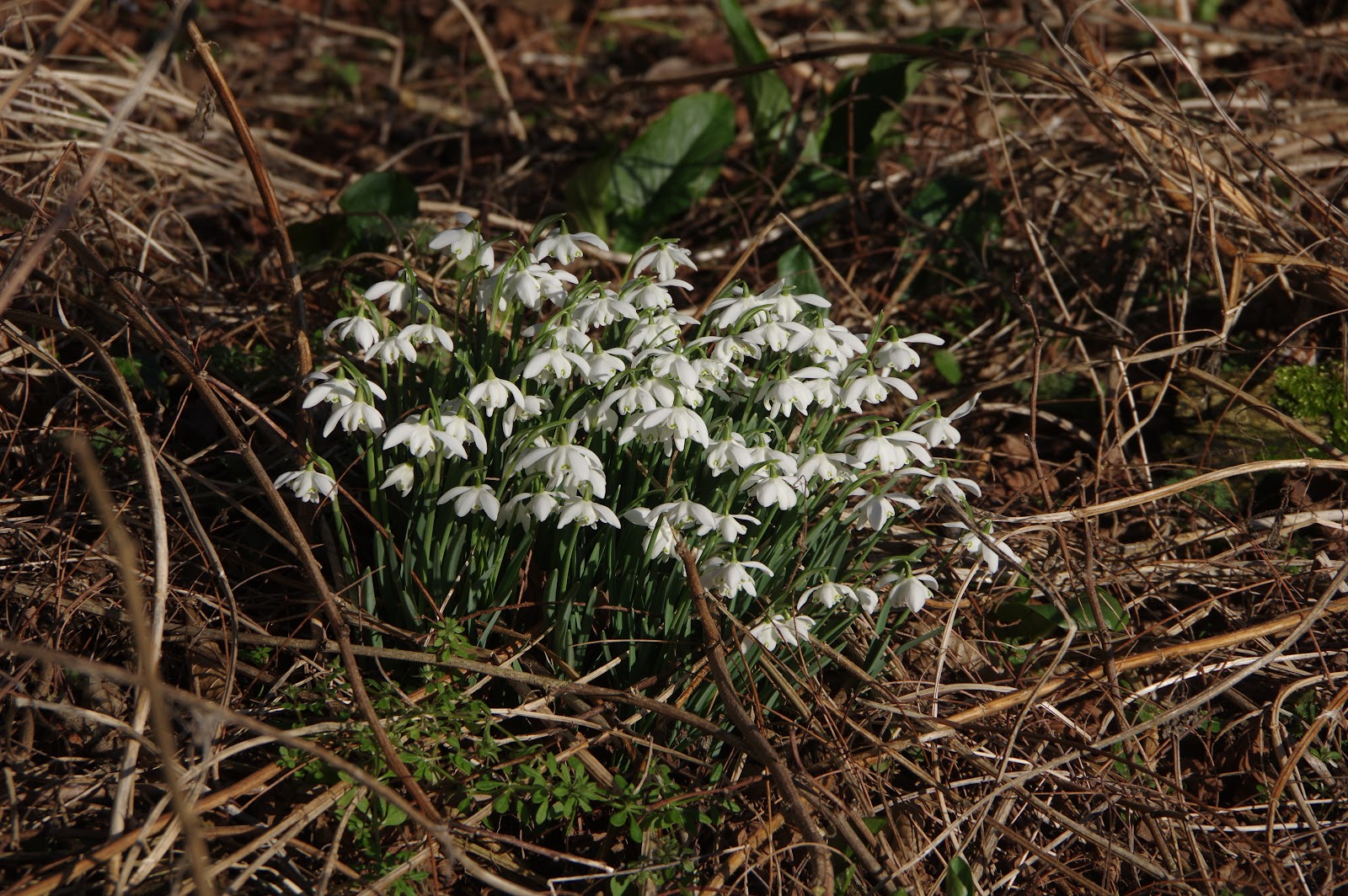
 Snowdrops in the woods. Appropriately I saw these yesterday February 2nd. which is Candlemas and Snowdrops were associated with this celebration in the Christian calendar. For the pagans among you the first and second of the month was Imbolc, the Gaelic festival of early spring.

Sunday, 2 February 2025


 I always feel spring is on the way when I see Winter Aconites and Snowdrops in flower...