Tuesday, 12 November 2024


 Flowers are few and far between till spring arrives. Nonetheless the occasional wild flower may suddenly appear out of season for no apparent reason. This looks like the annual 'weed' Nipplewort (Lapsana communis) on a bank that is covered with them during mid to late summer. This solitary specimen is very early (or very late). 


Sunday, 10 November 2024


 The 'woodland walk' at the music school is really only a fringe of the grounds but it feels secluded. On a grey day like today it conjured a walk in the woods. The air was cold, still and damp. Plenty of greenery and the russet tones of autumn. Fallen leaves underfoot, squashy and scrunchy.

Thursday, 7 November 2024


 Bumblebees are still on the wing here and there when autumn days are mild. Being furry creatures they tolerate a certain amount of cold and are generally indigenous to temperate rather than tropical zones. Indeed it is speculated that the Himalayas may be their point of origin.
 Honeybees need temperatures of around ten degrees Celsius or more to be able to fly and function. Nonetheless they too will venture out quite late into the year if it is warm enough. The hives at the music school were still fairly active as of a few days ago.
 Bumblebees will forage different plants seeking out sporadic flowers e.g. the Borage mentioned in my last entry. Honeybees work species that are flowering en masse; by this point in the year that means Ivy.

Wednesday, 6 November 2024


 The Borage on the allotment is still in flower and still attracting bees. Usually it's done by now. I'm wondering if they might overwinter. 
 Typically Borage is grown as an annual but sometimes lasts long enough into autumn to become a coarse, bristly-looking plant with thick stems as is the case here. In which case it seems to have the stamina to become a short-lived perennial in some locales.
 Then again the allotments are something of a frost pocket. Borago officinalis is a Mediterranean species and unlikely to cope with a prolonged spell of sub-zero temperatures. Go back a few decades and it would be unusual not to have had a hard frost by now in southern England. Now it's common to have to wait till December or January.

Tuesday, 5 November 2024


 The Jerusalem Artichokes grew mighty tall and lush this year. Now the leaves on the stems are starting to yellow and fade. Below ground there will be hundreds and hundreds of the edible tubers. 
 More than anyone could eat without exploding! They should be eaten with care (I speak from experience). Tasty and good for the gut microbiome but potentially 'gassy'.
 Being of the Sunflower family they have bright yellow flowers. Except they rarely and barely flower in UK conditions in my experience despite growing strongly.


 There are actually two beds side by side. On the left one of the usual varieties (not sure which) reached a good ten foot/three metres tall. On the left is a "dwarf" variety which nonetheless grew to about six feet! 
 I'll grow both again next year but I have read it's a good strategy to cut the stems at about five foot high. This prevents them being wind blown and directs more energy into the growth of the tubers. Not that it seems to matter here.


 No need to waste all that good organic matter. I adopted the 'chop and drop' approach and they can mulch themselves. I cut the stems just above the ground so I can locate the clumped tubers when I come to harvest them.
 It's said that Jerusalem Artichokes are a touch sweeter after frost. in any case I'll start harvesting them soon and then for the next few months. The best way to store them is to leave them in the ground until you want to eat them. 
 A very productive crop with little input required: plant them and they grow, chop and drop, harvest, replant spare tubers in February/March. Each tuber grows a handful more. Simple, delicious!

Monday, 4 November 2024

Sunday, 3 November 2024


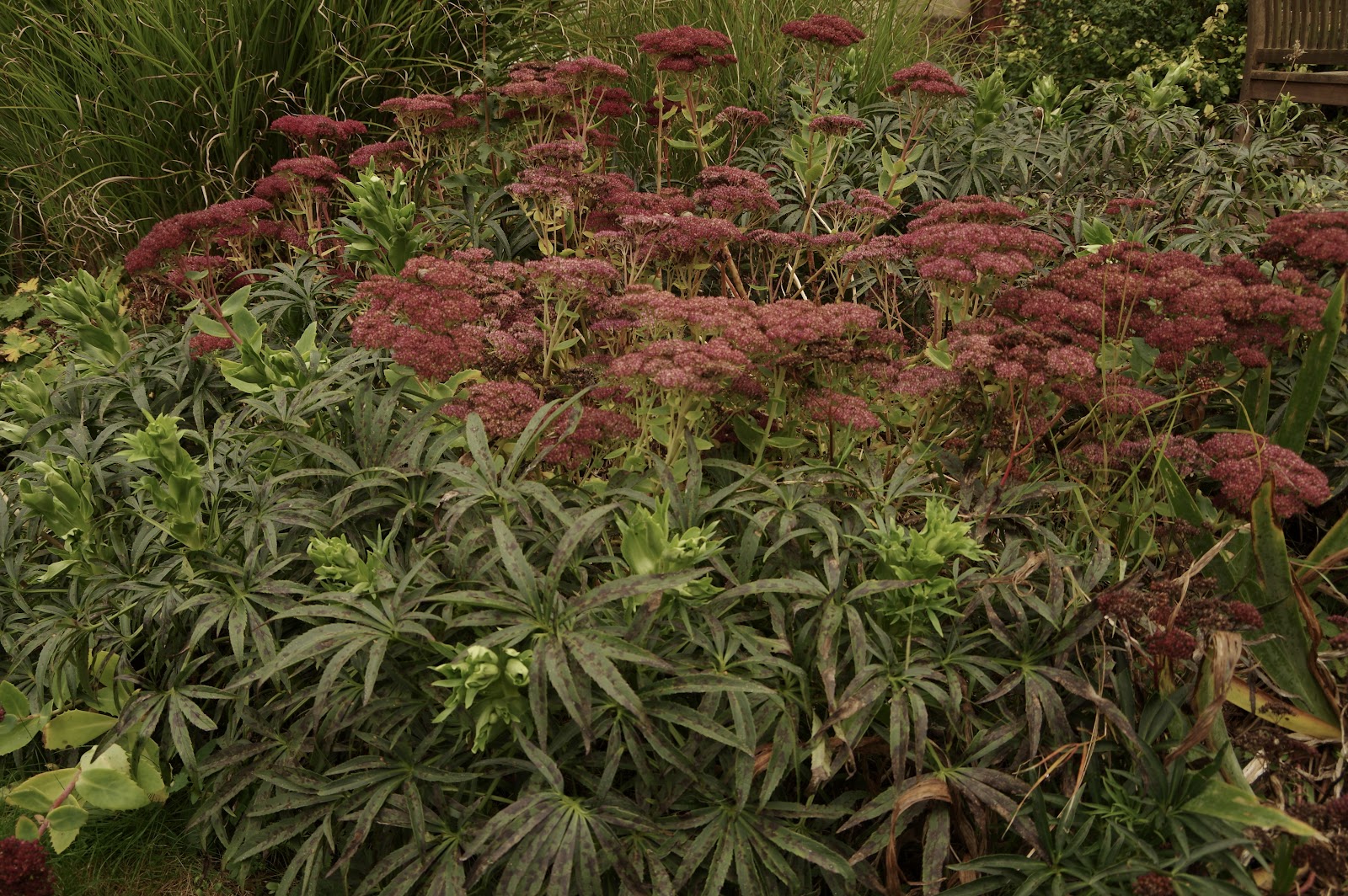
 A nice combination: Sedum and Hellebore as planted by Jif at the music school. Sedums flower in autumn, great for late colour in an herbaceous border. Helleborus foetidus is generally considered to be winter flowering i.e. January onwards. As I noted recently it seems to have reset its biological clock to begin flowering from mid-October. So there is now a striking overlap between the two.
 H. foetidus is native and I had always assumed that Sedums were introduced as garden plants. In fact S. telephium aka Orpine is native. And some of the popular garden Sedums are hybrids with the Chinese/Korean species S. spectabile for example 'Autumn Joy'. Actually I'm not sure which this is, probably one of the cultivars. Since Orpine is indeed native I'm wondering why I've never seen it growing wild?