Wednesday, 12 June 2024


 A late afternoon walk over Hoo Bit and the Pegsdon Hills. Many, many Orchids in flower. They seem particularly tall and sturdy this year. Indeed that is true of many plants. There are Stinging Nettles on the allotment over six feet high!

Monday, 10 June 2024


 Ivy Broomrape (Orobanche hederae) is thriving in the grounds of Benslow music school. That is intriguing because Brian Sawford characterised it as "one of Hertfordshire's rarest wildflowers" in his excellent book 'Wild Flower Habitats of Hertfordshire' which was published in 1990. 
 He notes that "it was unexpectedly discovered in a churchyard in northern Hertfordshire in 1984, parasitic upon Ivy tumbling over a few ancient limestone tombstones and by an adjacent gravel drive". Moreover he states that "These are the only colonies of this normally maritime species ever known from the county, and the only location in the whole of the Eastern part of Britain, north of the River Thames". He speculates that seeds may have clung to the tombstones quarried on the Isle of Portland in Dorset. As he alludes to O. hederae is an obligate parasite without chlorophyll and its host plant is Ivy.


 Ordinarily we might assume that rare wildflowers are getting rarer. However the 2020 Plant Atlas of the Botanical Society of Britain and Ireland describes coastal populations as stable but increasing in gardens and urban areas. It speculates this may be by wind dispersal or as a contaminant of top soil.
 I came across an article from 2019 in the Benslow newsletter by Gill Langley "Hitchin resident and Broomrape enthusiast". At the time she reckoned there were at least 130 plants there (I haven't counted!) and mentions five other sites in the county. Has O. hederae increased since that first discovery in 1984 or has it simply been noticed in other locations?


 How it came to be at the music school is a mystery. Benslow was formerly a rather grand country house and grounds; numerous wild species persist albeit surrounded by the expansion of Hitchin. Then again building works have taken place and Jif has developed the gardens with substantial planting over the course of several decades. Possibly the seeds and/or tissue arrived as 'contaminants'? Or perhaps the seed blew in on the wind and found ideal conditions?
 For whatever reason the rare and wonderful Ivy Broomrape is well established at Benslow. 

Sunday, 9 June 2024


 There are several large beds at the music school as created by Jif in the tradition of the classic herbaceous/mixed border. Perennials and shrubs are the backbone of the planting but various self-seeding annuals and biennials are prolific and can be relied upon to fill any gaps in a most attractive way. Case in point the sky blue flowers of Love-in-a-Mist (Nigella damascena)...  

Saturday, 8 June 2024


 The wild Dog Rose (Rosa canina) scrambles over hedge banks, scrub and the edges of woodland. Prolific and an important source of nectar.
 Plants are sometimes given the epithet 'dog' if considered inferior. It's hard to imagine that this lovely rose would be thought less worthy than others. Or it may be from the Old English 'dag' i.e. dagger in reference to the thorns. 
 Then again Pliny refers to a rosa canina whose root could cure the bite of a rabid dog. Most botanical nomenclature has been invented in the past few centuries by Linnaeus et al whereas the the name of our humble Dog Rose dates back to classical Latin.   

Wednesday, 5 June 2024


The humps of Knocking Hoe are shimmering slopes of grasses.


 Many common and uncommon wildflowers of chalk grassland can be found here including Dropwort (Filipendula vulgaris).


 A great locale to see Common, Pyramidal and Fragrant Orchid. And a real rarity: one of the few colonies of Burnt-tip Orchid in the country. Most of the others are in Wiltshire.


 Knocking Hoe is a nature reserve managed with conservation in mind. Sheep graze the hills in sections divided by low electric fences. In some areas the grass is left long, in others the turf is chewed to a short sward thereby favouring different wildflowers in different places.

Tuesday, 4 June 2024


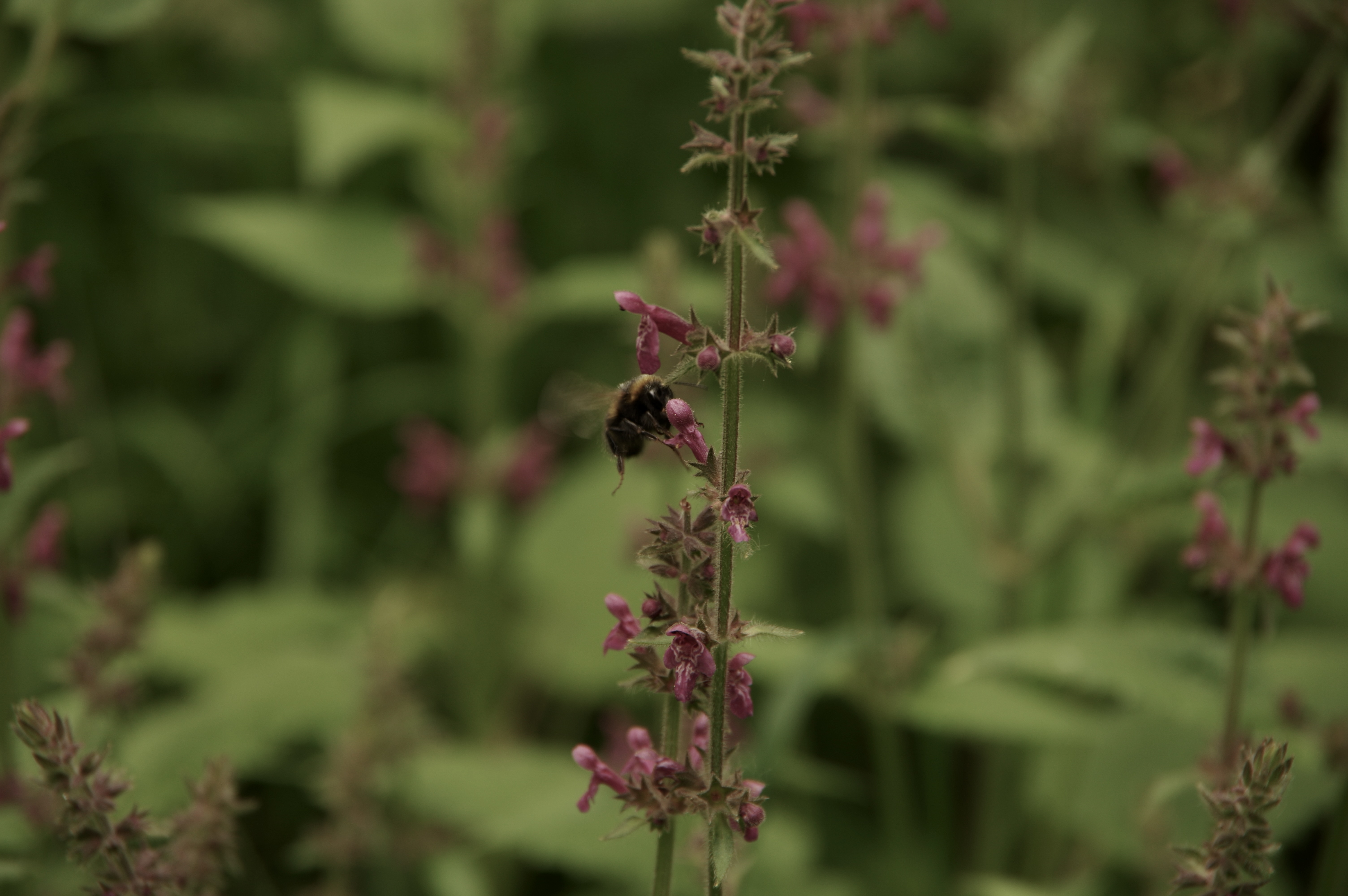
 Stachys sylvatica is the Latin name coined by Linnaeus for this species. It is indeed a plant of sylvan glades and woodland rides. The common name Hedge Woundwort is also indicative of its habitat as well as alluding to the perceived medical use in earlier times.
 Often found among Stinging Nettles and is of the Lamium genus sometimes referred to as Dead-nettles i.e. no sting. Hedge Woundwort is much visited by bees. 

Monday, 3 June 2024


 The Mullein on a Mullein i.e. the caterpillar of a Mullein moth feeding on a plant of the genus it favours and is named after. Vivid in colour and pattern whereas the moth itself resembles a fleck of wood.