Sunday, 9 April 2023


 Dog Violets (Viola riviniana) pop up all over the place in sun or shade, town or country. Like Red Deadnettle mentioned a few days ago they seem to be especially prolific this year. It might be my imagination but I think there is a greater variation in colour than usual- many hues of blue/purple/mauve. There is also a pure white form.
 The unscented V. riviniana was probably called 'Dog' Violet to imply it is inferior to the fragrant Sweet Violet (Viola odorata). That's a bit harsh!

Saturday, 8 April 2023


 The blue flowered Comfrey Symphytum caucasicum is coming into flower. Says Beth Chatto: "invasive in the wrong place, but where allowable one of the delights of spring". I have allowed it in several places and if it proves to be invasive that will delight me even more.

Friday, 7 April 2023


 A flower for Easter. The Pasqueflower (Pulsatilla vulgaris) blooms in April, its common name derives from archaic French ("pasque" or "pasques" meaning Easter) or perhaps the Hebrew "pasakh" meaning Passover.
 I was thrilled to see these few when I took a walk over the chalk hills near Hitchin earlier in the week. Not only are they rare in Hertfordshire they are very, very rare in the country as a whole. They persist in only a handful of sites and several of the best are in Herts. 
 Some wildflowers are generalists but Pulsatilla vulgaris requires a very specific habitat: sloping chalk grassland undisturbed but grazed to a short sward. Lore has it they grow in places where Viking blood was spilled. Perhaps that happened here though I haven't seen any Vikings recently. 
 Like Easter the arrival of the Pasqueflower varies by a week or two from year to year. More will follow; a hillside of Pasqueflowers in bloom is a wonderful thing to see.

Wednesday, 5 April 2023


 Red Deadnettle (Lamium purpureum) seems to be particularly prolific this year. I'm seeing large patches of it in sunny, grassy areas and it's generally taller than usual. A humble weed/wildflower but important for emerging pollinators.
 The thirty or so species in the Lamium genus are often referred to as Deadnettles (or Dead Nettles or Dead-nettles!) for their passing resemblance to Stinging Nettles but with no sting. 

Tuesday, 4 April 2023


 The countryside is full of blossom. This track near Pirton in Hertfordshire is marked on some maps as 'Green Lane' and on others as 'Wood Lane'. What remains of the ancient hedgerow puts on a beautiful display in spring. At first glance I thought this might be more Blackthorn [see last entry] but no thorns so probably Cherry Plum (Prunus cerasifera)? 


 I saw many honeybees on the blossom and this critter which looks to be a bee fly rather than an actual bee. The Bombyliidae are sometimes referred to as bee mimics.   


 Unlike a bee it hovers over the flowers to forage. Note the long tongue! 

Monday, 3 April 2023


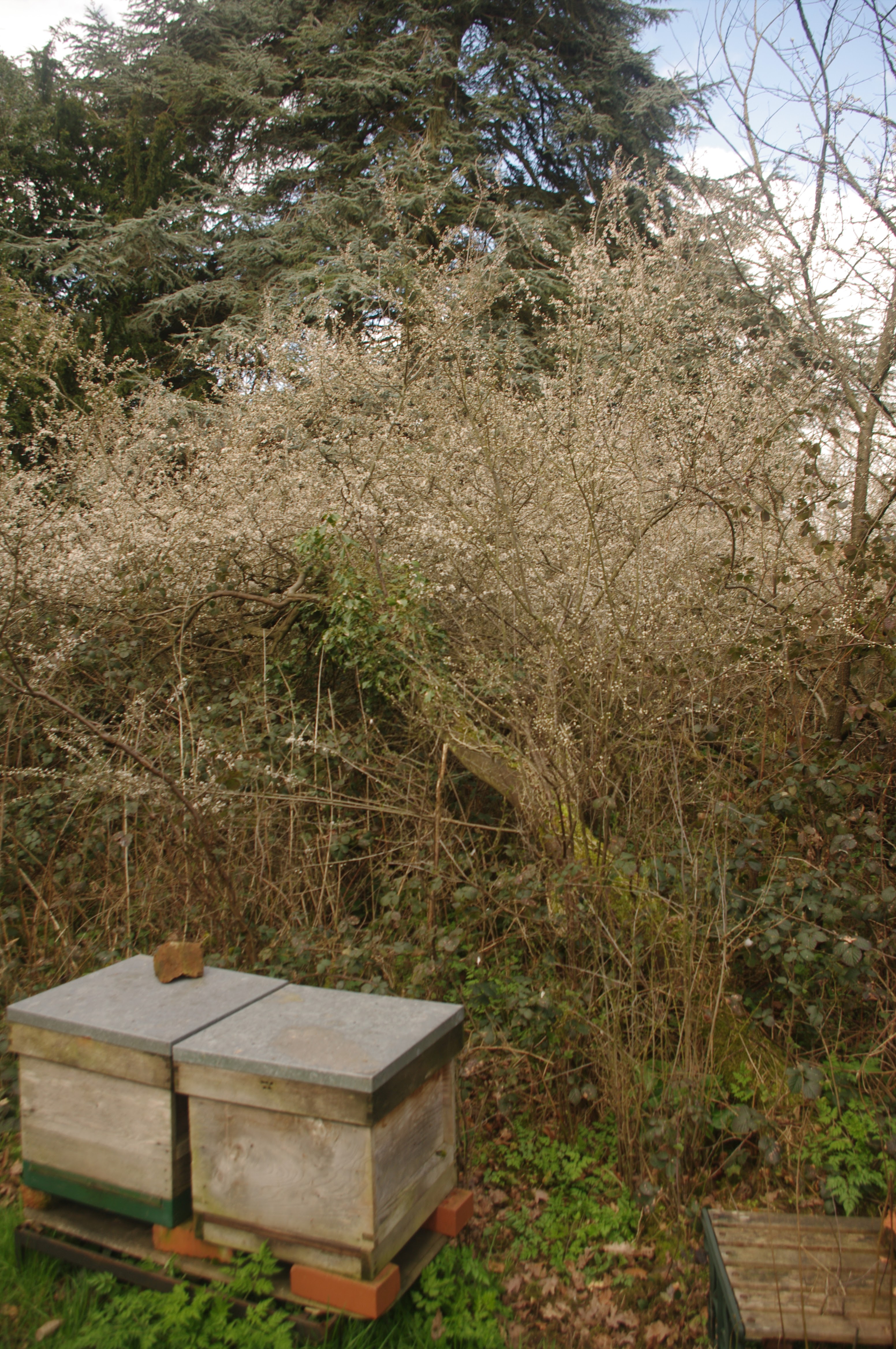
 Blackthorn in bloom. I thought this was a dense thicket...


 Walking around the other side reveals it to be a tree sized Blackthorn fallen on its side that carried on growing. A number of smaller ones are clustered around, probably self-seeded. Prunus spinosa can be a large shrub or a small tree depending on habitat and management (or lack of).
 Hawthorn and Blackthorn were the principal components of stock-proof hedges. In the form of trees they are often remnants of old hedgerows, perhaps that is the case here? Or perhaps this one was originally planted to produce a crop of sloes? There are other fruit trees nearby.


 A collection of bee hives stands in an adjacent clearing. Today has been the sunniest day of the year so far and the bees were buzzing in and out. Blackthorn is one of the earliest of our native species to flower; the mass of blossom provides a great source of pollen and nectar.

Saturday, 1 April 2023


 Somewhere I have a copy of an old book on botany book called "Wayside Weeds and Wildflowers". That title has always stuck in my mind when I'm out and about. The wayside is indeed a good place to spot those plants which may be called weeds or more accurately wildflowers.
 White Comfrey (Symphytum orientale) seems to be becoming more and more prolific in that regard, at least in North Hertfordshire. This form of Comfrey is native to the Eastern Mediterranean originally so the recent dry summers may have helped; likewise the calcareous/sandy soils hereabouts. Actually it is worthy of a place in any garden though I'm happy to see it by the wayside.