Wednesday, 13 April 2022


 A trip to the allotment, the first for several weeks. I took a Sedum and a Hosta that someone had kindly left in the surplus box.


 White Comfrey and Raspberry canes.
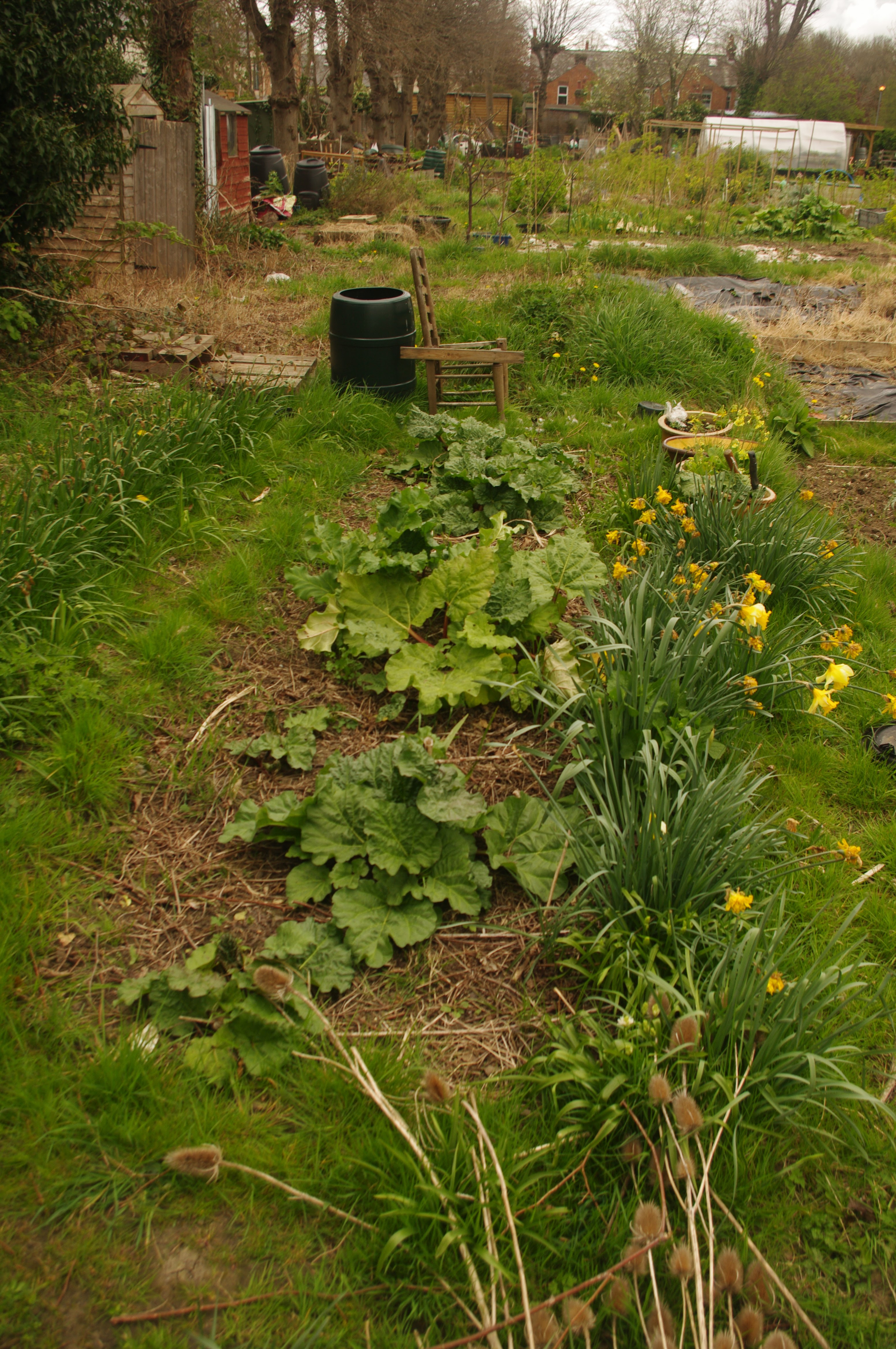


 Rhubarb Rhubarb


 Symphytum ibericum in full flower and attracting bees.


 Red Campion and Wild Tulip in the wildflower bed. 


 The perennial bed: Sage, Fennel, Chives, Babbington's Leek, Lovage, Lemon Balm et al.


  Red Deadnettle doing well in this wheelbarrow with no wheel.


 I prepared this bed to sow with various flowery edibles: Chicory, Cornflower, Black Caraway, Pot Marigold, Wild Rocket. Borage already self-seeds here.

Tuesday, 12 April 2022


 Warm and sunny today. Sleepy honey bees were emerging from one of the hives at Edible Landscapes in Finsbury Park.

Monday, 11 April 2022


 Like many houses in England the house I grew up in has a Privet hedge in the front garden. Among the greenery are the bright red flowers of a Flowering Quince. Not to be confused with Quince Tree this is the shrubby Japanese Quince (Chaenomeles spp.) possibly the cultivar C. superba 'Crimson and Gold'.


 On the other side of the hedge the view is a bit more 'street'.


 Japanese Quince grows fine as a freestanding shrub but is very amenable to being used as a hedging plant. The hedge has been here well over half a century and the Quince with it; I wonder whether they were planted together or separately? I give the hedge a trim once or twice a year but other than that no maintenance is required.
 Postscript My father notes that he planted the front section of the hedge in the late sixties. He bought a dozen or so bare root plants from a market gardener who had a plot of land not far from the house (now a housing estate needless to say). The side section he planted in the seventies using stems from my grandmother's garden.
 The Quince was already there when my parents moved in so who knows how old it is. It merged with the Privet over time and they continue to co-exist. 

Sunday, 10 April 2022


 Like most gardeners I have my successes and failures. I had chalked up my attempt to establish Snake's Head Fritillary as a failure. This is a species which is extremely rare in the wild where it requires a very specific habitat: a free draining soil which floods in winter. 
 Some years ago I planted fifty bulbs of Fritillaria meleagris and they amounted to nothing. A back garden in South London clearly failed to approximate their natural habitat- or so I thought. Today I noticed a couple have survived and seem to be doing alright. So I'll persist and buy another ten or twenty in the autumn to see if more will grow in the same spot.
 By way of a contrast tens of thousands grow in the water meadows of Magdalen College, Oxford [see entry dated 17th. April 2017]. Surely one of the greatest sights in all England...


Saturday, 9 April 2022


 Honesty (Lunaria annua) has purple flowers but there is also the striking white flowered form which needless to say is known as White Honesty (L. annua var. alba). As I mentioned recently both self-seed around the garden though for some reason White Honesty seems to be the more vigorous of the two in this setting. That is curious because they are one and the same species but the purple is more common, in fact I hardly ever see White Honesty. 
 I'm referring to them as different forms but strictly speaking var. alba indicates that it is considered a variety i.e. below the taxonomic rank of species and subspecies but above the rank of form. Then again the white flowered Foxglove is Digitalis purpurea f. alba. Why is White Honesty a variety and White Foxglove a form??   

Tuesday, 5 April 2022


 It doesn't get much simpler than pea sticks. When something straggly needs supporting make a wigwam or lattice of sticks stuck into the soil. Climbers will latch onto them and start climbing. Pea plants are a case in point hence the name.
 In fact the plant in the large tub is Everlasting Sweet Pea (Lathyrus latifolius) rather than the vegetable but the principle is the same. The natural habit of L. latifolius is to climb and scramble and needs something to support it.
 Hazel is the traditional choice for durability and flexibility but here I just gathered a miscellaneous collection of sticks that were lying nearby.

Sunday, 3 April 2022


 The white and purple forms of Honesty (Lunaria annua) self-seed freely around the garden. I introduced a few of each in years gone by and now they pop up wherever takes their fancy.
 L. annua is (despite the name) a biennial in my experience; perhaps it grows quicker if conditions are favourable? Introduced from Europe it has naturalised in the UK and I'm very happy to let it fill in any bare spots of soil. The rosette of leaves adds greenery in the first year of growth and the flowers are very pretty the following spring. After flowering the coin-like seed pods start off green then dry out to a papery pale white in late summer/early autumn. 
 Hence the Americans call it Silver Dollar Plant. Some say money is the root of all evil so I'll stick with Honesty.