A diary of back garden botany, urban ecology, rural rambles and field trips to the middle of nowhere...
Sunday, 17 May 2020
There is something unearthly about parasitic plants. The subject comes to mind because I've been corresponding with someone about a mystery species they spotted which may or may not be a parasitic plant.
The one shown above is a Snowflower (Sarcodes sanguinea) which I saw last year when I was hiking in the mountains around Lake Tahoe in California. Few other wildflowers grow in the arrid soil of the pine forest but these were frequent. They emerge after the snow melts hence the name.
Unlike the vast majority of plants S. sanguinea does not contain chlorophyll and does not photosynthesize. Instead it derives sustenance from mycorrhizal funghi attached to the roots of trees. Symbiotic might be a better word than parasitic: it gives fixed carbon to the fungus and takes from it minerals and water.
Saturday, 16 May 2020
Friday, 15 May 2020
The flowers of Borage (Borago officinalis) are manna for bees. It is reckoned that a Borage flower refills with nectar every few minutes.
B. officinalis is generally described on seed packets as a hardy annual; often as not it will indeed grow and bloom and die within the space of a single year. But I have noticed that some plants overwinter and last at least a year or two forming much larger specimens with particularly coarse and bristly stems and leaves.
Thursday, 14 May 2020
I saw these beautiful drifts of Wild Clary (Salvia verbenaca) on Windmill Hill in Hitchin, Hertfordshire- my home town. It's a mystery to me why I haven't noticed them before!
Initially I thought it was Meadow Clary (Salvia pratensis) but that didn't seem to make sense. Meadow Clary is now so rare that it made national headlines about ten years ago when twelve plants were stolen from a nature reserve in Kent.
A friend who lives in Hitchin pointed out that these are Wild Clary aka Wild Sage which is more widespread though nonetheless in decline.
At first I assumed it was restricted to the unmowed banks on the edge of the hill. When I looked more closely I saw the wrinkly grey-green leaves were growing in the grass everywhere. If Windmill Hill was uncut and untrodden it would be covered in the flowers of Wild Clary.
Perhaps it has been sowed to enhance biodiversity but I assume it is a surviving colony of the species dating back to Hitchin's rural past. Certainly it is a plant of sunny, dry, calcerous grassland and Windmill Hill corresponds to its natural habitat.
The flowers are characteristic of the Salvia family.
Really quite stunning to see the purple haze against a froth of Cow Parsley.
The loss of flowering grasslands has been widespread and severe so a fragment like Windmill Hill should be cherished.
Wednesday, 13 May 2020
I'm frequently asked what this plant is by visitors to the garden during the neighbourhood's annual Open Gardens weekend in May. Needless to say the event has been cancelled this year but the plant has made its usual entrance.
I'm surprised this species isn't more used in gardens given how reliable and attractive it is. The Latin name is Melittis melissophyllum but it has a curious common name: Bastard Balm. There seems to be considerable variation in colour, including a white form and a much paler variation of the ones I have in the garden.
It is said to be a wild plant of ancient woods and old hedgerows in South West England but it must be rare. I have never seen it on any of my rambles in that part of the world.
Tuesday, 12 May 2020
The garden is very lush and green by this point in the year. The tree canopy has filled out in leaf and the taller plants start to dominate. In terms of flowering there is something of a lull at this point; many of the spring flowers have faded and the summer flowers are yet to kick in. In a few weeks for example this scene will be a sea of pink when the numerous clumps of Geranium x oxonianum come into bloom.
Monday, 11 May 2020
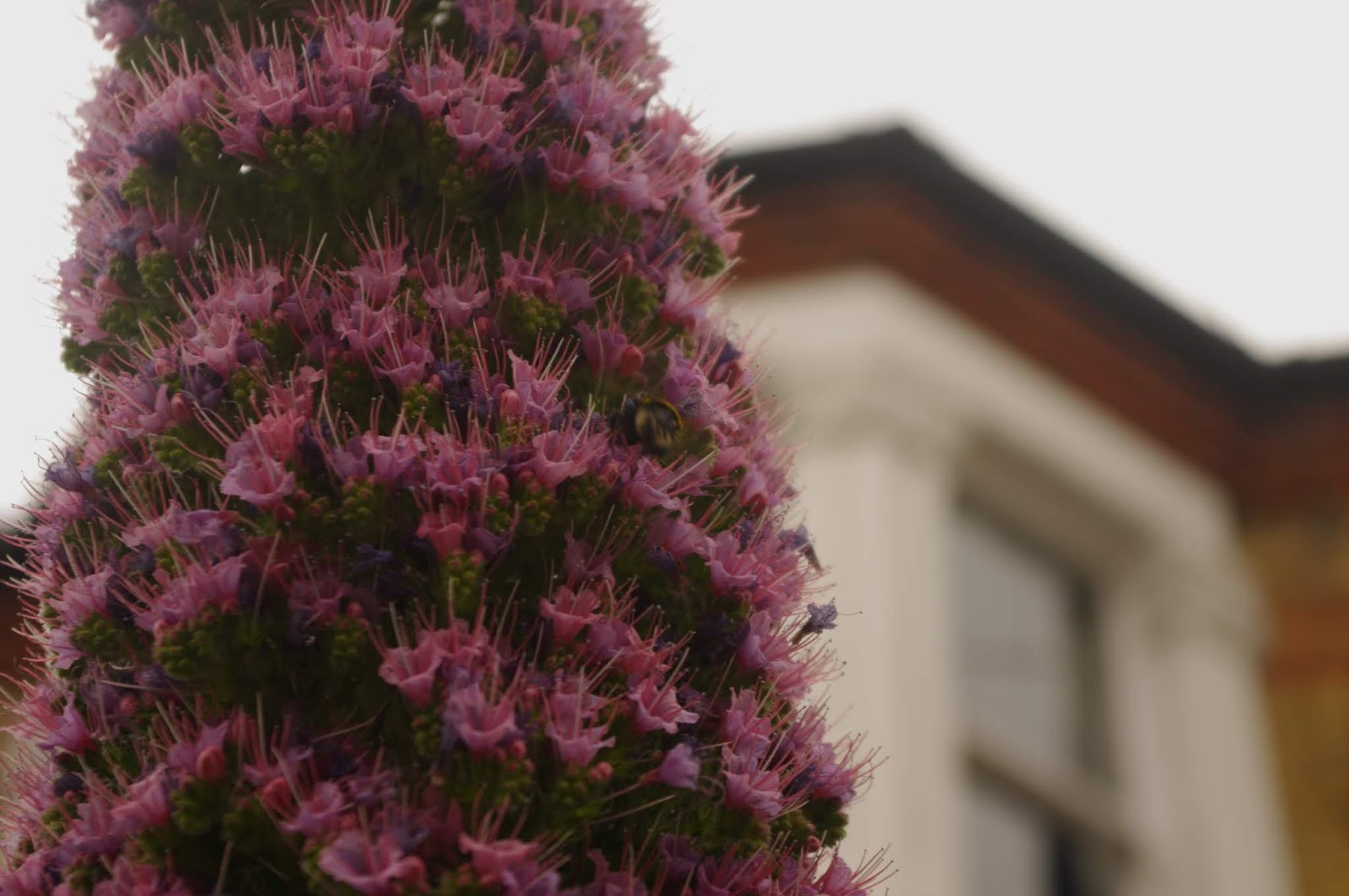
Pretty wild- this is Echium wildpretii, sometimes called Tower of Jewels. It was given to me by one of the gardeners at the South London Botanical Institute when it was not much more than a seedling in a small pot. Unusually E. wildpretii is triennial. In year one it grows from a seedling into a small plant with a rosette of leaves. In year two it develops a stout stem about a metre tall with long slender leaves. In year three it throws up the tall spire encrusted with flowers, seeds prolifically then dies.
E. wildpretii hails from the Canary Islands. The blue flowered E. pininana aka Tree Echium from the same part of the world is starting to naturalise in warmer parts of the UK including London but the Tower of Jewels is rarely seen. It lives up to its name by bearing thousands of flowers which attract honeybees and bumblebees in great numbers.
NB one caveat as to the plant ID. I have seen photographs of E. wildpretii on the Canary Islands with bright red flowers. There is also a form where it hybridises with E. pininana which is sometimes referred to as Pink Fountain. The flowers on the one I have are somewhere between pink and red so I can't be entirely sure whether this is a Tower or a Fountain!
I would love to see these enormous Echiums in their natural habitat. Picture if you will an arid volcanic landscape. It looks like nothing should really grow there but there are Echiums all around, standing tall.
A bit different to South London I suppose but I'm very pleased to have this exotic alien in the front garden.
Subscribe to:
Posts (Atom)