Sunday, 8 March 2020


 Heralds of spring: Lungworts growing among Primroses and Celandines.

Friday, 6 March 2020


 I have a few Oxlips (Primula elatior) in the garden and will add more. They are woodland plants and seem to grow well on London clay although their native habitat is the boulder clays of Eastern England. When I started planting wild species I had hoped to establish Cowslips (Primula veris) but the clay and partial shade does not suit them. I should have taken note of where Cowslips thrive: open sunny sites on chalk.


 Case in point I saw thousands of Cowslips waving in the breeze on a spring walk last year on the hills overlooking the Vale of Pewsey [See entry dated 29th. April 2019]. The Oxlip is a close relative and every bit as lovely so an agreeable alternative to my original intention.
 Both are related to the Common Primrose (Primula vulgaris). Happily it is indeed common and grows freely all over the place be it country lanes or urban gardens.

Thursday, 5 March 2020


 The wild species Narcissus cyclamineus is native to Spain and Portugal but not widely cultivated. Nonetheless it is a parent of numerous hybrid daffodils; 'February Gold'  for example (above) is N. cyclamineus x pseudonarcissus. The swept back petals demonstrate the cyclamineus lineage.


 'Rapture' is another cultivar and the petals are even more reflexed. This and the long down pointing corona give it a strong resemblance to the species though 'Rapture' is a bit taller; N. cyclamineus grows to about 6-10 inches (15-25cm).

Wednesday, 4 March 2020


 The Wild Daffodil (Narcissus pseudonarcissus) has a widespread though sporadic distribution through England and Wales with strongholds in certain areas like the Lake District. Mysteriously it flourishes in such locales but not in others which should be equally suitable as habitats.
 The photograph above was taken in Lesnes Abbey Wood in South East London a couple of years ago. This fragment of an ancient landscape has long since been surrounded and cut off by the expansion of London yet retains large populations of Wild Daffodils, Wood Anemones and Bluebells. [See entry dated 16th. March 2018]
 I haven't really succeeded in naturalising N. pseudonarcissus in the garden but there is another wildling that does better:


 This is the Tenby Daffodil, sometimes called Narcissus obvallaris and latterly Narcissus pseudonarcissus subsp. obvallaris. It was endemic to the Tenby region of South Wales before entering mass cultivation. If it is a sub-species it looks rather different and it's unclear why it was particular to one part of the country.  
  There are other variations of the Wild Daffodil -which is also found on the continent- and I have yet to read a definitive explanation of whether it is one or several species.


 Growing nearby I have Narcissus Telamonius Plenus which may be a double form of N. pseudonarcissus (a rather shaggy one at that). I bought a handful from Shipton Bulbs in Wales. If I may quote from their catalogue:
 "These daffodils appear in woodlands all over Britain... They are nowadays associated with the very old variety N. Van Sion, introduced in the 17th. Century but the forms inhabiting our British woods and gardens are much smaller and wilder looking than the Van Sion offered by Dutch growers today".
 If Telemonius Plenus aka Van Sion is a relative of N. pseudonarcissus it looks closer to the Tenby Daffodil than the Wild Daffodil. Daffodil DNA seems to be somewhat obscure. 

Tuesday, 3 March 2020


 Low to the ground spring flowers are stirring.
Like these dainty Corydalis Beth Evans.


 Creeping Comfrey (Symphytum grandiflorum) is creeping around.


 Lungworts (Pulmonaria spp.) raise exquisite flowers above speckled leaves. 

Monday, 2 March 2020


 There will be a Daffodil theme to some of this week's entries because quite a few are flowering in the garden at the moment. I generally prefer wild species to cultivars but Narcissus Tete-a-Tete is early, reliable and cheerful.


 Narcissus WP Milner is another cultivar, bred by one Henry Backhouse in the Victorian era. Various sources state that it appeared around 1869 which must make it one of the oldest "heirloom" varieties. The early hybrids often have a grace and simplicity that is lacking in some of the many that followed
 W.P. Milner looks rather like our native Wild Daffodil. In fact so much so that I hope I've made the correct ID, I can't actually remember which I planted in this spot! The petals are swept forward and almost hide the trumpet which is a characteristic of the Milner.     

Sunday, 1 March 2020


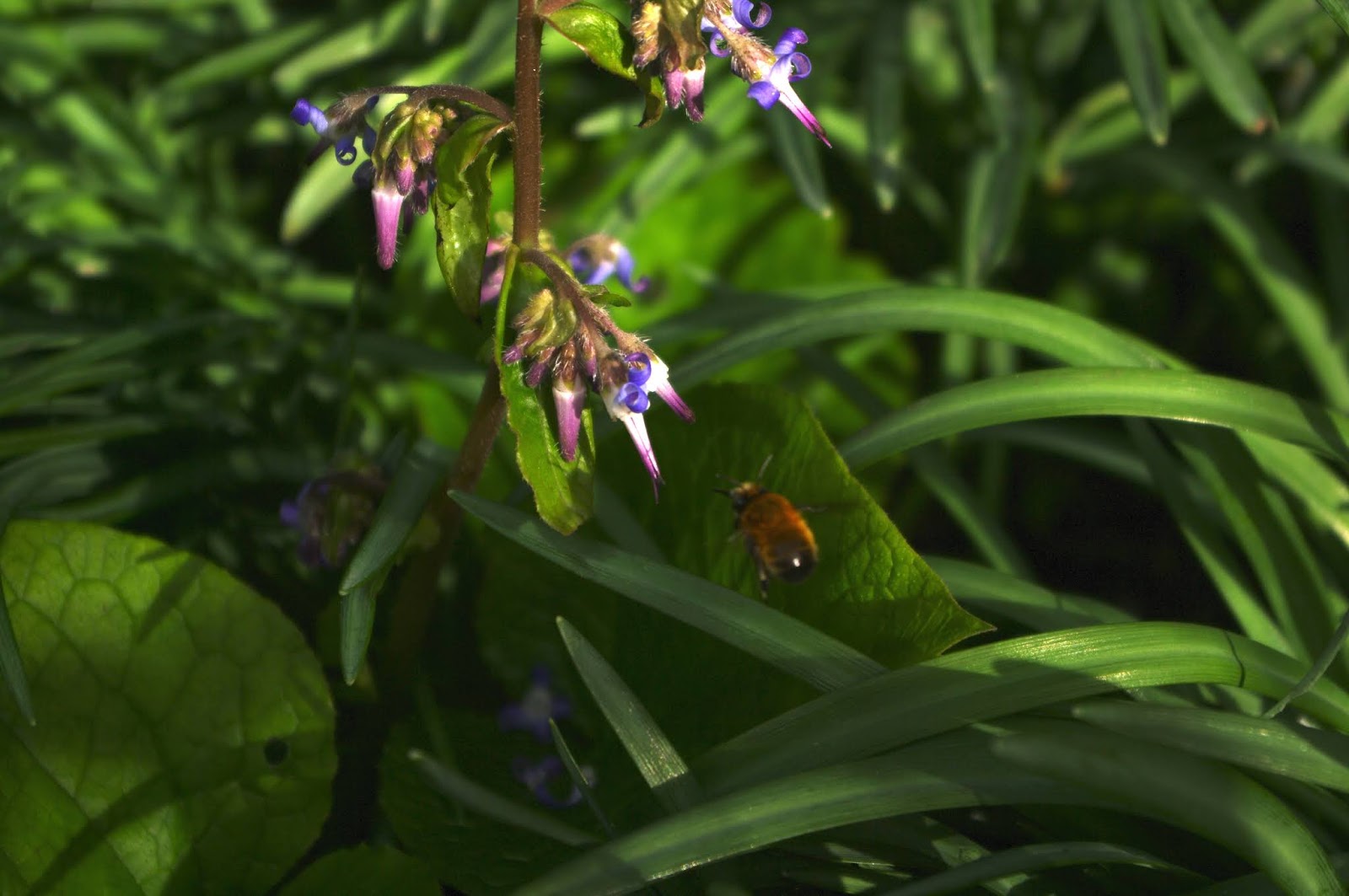
 This weekend I have seen the first bees foraging in the garden! In previous years I have spotted them from late Jan/early Feb taking advantage of the Snowdrops, Hellebores, Crocuses and Daffodils. It hasn't been especially cold this winter but it has been very, very wet which bees struggle with.
 Fortunately the Trachystemon orientalis is coming into flower and it's a bee magnet (as is the case with many plants of the Boraginacae family). The flowers look rather similar to the annual Borago officinalis hence it's sometimes called Oriental Borage.
 In his book 'Dream Plants for the Natural Garden' Piet Odulf places T. orientalis in the section titled "Troublesome invasive plants" but it doesn't trouble me. I planted it in a dry shady area where few plants would flourish and it's fine. The bees think so too...