A diary of back garden botany, urban ecology, rural rambles and field trips to the middle of nowhere...
Sunday, 11 August 2019
Tahoe trails part 3. Snow capped peaks, wildflowers and the trail- as I sift through the photos I took on my recent trip this one seems particularly evocative.
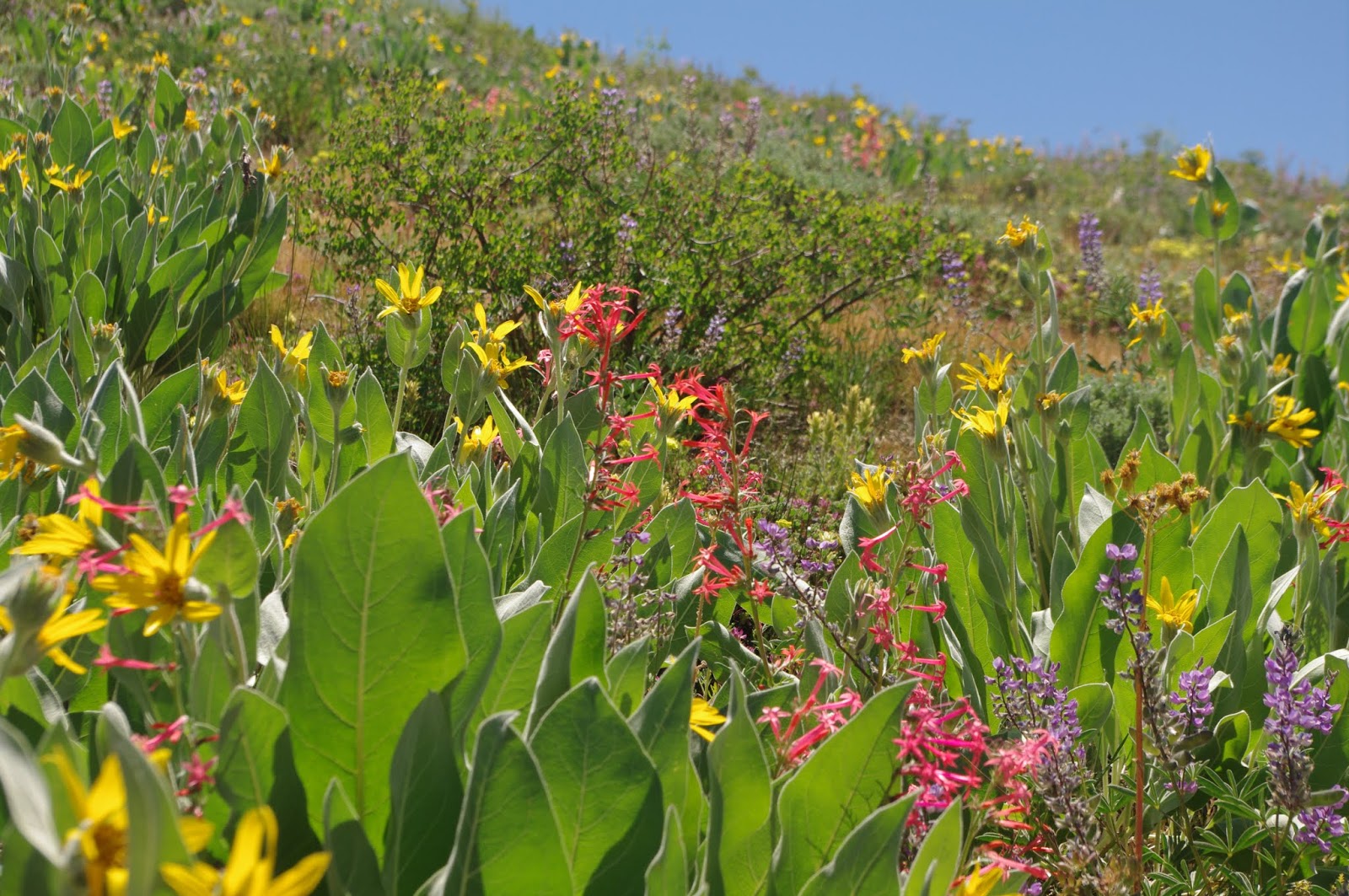
The exceptional winter in the Sierras meant there was still a lot of snow in places and the snow melt is followed by an eruption of wildflowers. Lupins and Woolly Mule's Ears were the most prolific species in bloom (often growing together as seen above).
The trail in the picture is the Pacific Crest Trail looking south towards Carson Pass. If you walk about 1100 miles in that direction you arrive at Campo on the Mexico border. If you head north for around 1500 miles you get to the Canadian border.
This is my fourth substantial hike in the States and I've met quite a few 'thru-hikers' on my travels. Perhaps one day I might be able to set aside four or five months to do the whole thing but until then the PCT has proved to be a good way to get to the middle of nowhere in search of wildflowers and far horizons.
Saturday, 10 August 2019
I planted Soapwort (Saponaria officinalis) in the garden a year or two back and it's slowly spreading and sprawling. Not a tidy plant but that doesn't matter in a 'wild' garden.
Centuries ago Soapwort migrated across Europe from the Middle East. The leaves contain saponins and can be boiled to make a mild detergent. The wool and cloth trades of their day made use of this property so it was probably propagated as a crop of sorts. A simple soap can also be made by rubbing the leaf between the hands with a splash of water which results in a thin (and very green!) lather.
Thursday, 8 August 2019
Tahoe trails part 2. Wildflowers were abundant on the slopes approaching Carson Pass and I took a couple of days to wander back and forth. Having parked my tent at Showers Lake several miles away I was able to walk out each day in a more leisurely fashion with just a few of the essentials: water, some nuts to snack on and the camera.
A single wildflower is beautiful in its own right but en masse the effect is particularly stunning. This hot, dry sandy stretch of the Pacific Crest Trail was carpeted with the bright yellow blooms of Woolly Mule's Ears (Wytheis mollis), the fiery red flowers of Scarlet Gilia (Ipomopsis aggregata) and the mauve/purple spikes of innumerable Lupins. There are the best part of two hundred species of Lupin in North America- these may well be Crest Lupin (Lupinus arbustus)?
I like a bit of botany but William Blake said it all really: "To see a World in a Grain of Sand/And a Heaven in a Wild Flower".
Wednesday, 7 August 2019
The shrubby Persicaria amplexicaulis looks good wherever I see it. I have it in the garden (above) and a couple of weeks ago I came across it growing extensively round a lake in a San Fransisco park. Yet it originates in the Himalayas, China and Pakistan!
Intense as they are the crimson red flower spikes seem to blend harmoniously with their surroundings and the stems and leaves have the toughness of a wild thing. Various cultivars are available, this one is either 'Firedance' or 'Firetail' I can't remember which (there's probably not much to choose between them). It prefers a bit of moisture but P. amplexicaulis is of the Knotweed family and these are very hardy plants; I can imagine it in some valley in the Himalayas.
NB Several weeks ago [30th. June] I posted a photo of our native Persicaria bistorta which I saw by a babbling brook in Edale, it's different but clearly related.
Tuesday, 6 August 2019
Tahoe trails part 1. The Amtrak train got me from Oakland to Sacramento where I connected with a Thruway bus to the town of South Lake Tahoe. The lake is one of the largest and deepest freshwater lakes in the States and functions in effect as a resort for holidaying Americans (including gambling which is legal on the Nevada side of the Stateline which runs through the middle of the lake).
I was bound for the great outdoors so I headed to the edge of town where an abandoned road provided the most direct route into the backcountry.
As I ascended from approximately 7000 feet above sea level to around 9000 feet vistas began to open up all around. I had gazed upon some mighty landscapes from the windows of the bus and now I was walking into them.
The Old Meyers Grade as this road is known took me up about 700 feet over a mile and a half or so at which point I could connect with trails to Echo Summit and beyond. It used to be a section of the Lincoln Highway, America's first intercontinental route circa 1915. Now traffic thunders in and out of Tahoe on Highway 50. Meyers Grade is closed to motor vehicles but popular with hikers and mountain bikers.
Beyond Echo my first night's camp provided me with a big sky and plenty of forest. Actually this was also the site of my last night's camp 10 days later. Essentially I did a loop of sorts round the territory known as the Meiss Roadless Area using sections of the Pacific Crest Trail and the Tahoe Rim Trail.
For the next 10 days my hiking alternated between forested sections and high mountain meadows. Tahoe and the Sierras had a massive amount of snow over winter, and it was still very much in evidence on the peaks...
... and sometimes on the trail. On day 2 I had a gruelling hike uphill on thick snow and I was relieved to get past it after a couple of couple of hours.
The PCT and TRT follow contours where possible which makes for somewhat easier walking when not ascending or descending the steep passes.
On my second day out of Tahoe I reached the idyllic Showers Lake and camped by its waters for several nights using it as a basecamp for some hiking round and about without the full backpack.
I particularly wanted to explore the section of the PCT between the lake and Carson Pass which is renowned for wildflowers. In alpine areas they begin to bloom in great profusion as the snow melts. Alas, so do the mosquitoes -they were pretty fierce in the early morn and later in the evening- but the flowers and dips in the crystal clear lake were sublime.
Monday, 5 August 2019
Returning to this country after several weeks away I see clear signs that high summer is moving into late summer. Various plants are going to seed and the seed heads can be as striking as the flowers- like these Papaver somniferum on the allotment. No, I haven't been growing a crop of opium; they seeded themselves so I'll let these self-seed in turn.
Similarly the Honesty (Lunaria annua) that flowered so vigorously in the front garden [see entry dated April 3rd. 2019] has produced a great many of the characteristic papery seed heads with the seeds clearly visible within:
NB It's worth collecting the seeds of a particularly good form of a plant. It's a great deal cheaper than buying them and the next generation may have similar characteristics when propagated and grown on. This single specimen of Honesty has produced hundreds of seeds, some of which I'll scatter and others I'll grow in small pots to be planted out in spring.
Sunday, 4 August 2019
Postcards from California- the streets of San Francisco and the trails of Lake Tahoe. I flew to the States July 15th. Spent a few days in the Bay Area then traveled by train to Sacramento where I connected with a bus that took me to Tahoe. I backpacked for ten days before returning to Frisco for another short stay, arriving back in London August 1st.
I'm in the process of sifting through many photos and will be posting a selection in the days ahead.
Subscribe to:
Posts (Atom)