Saturday, 9 March 2019


 Community gardens are part of the patchwork that makes up London's open spaces. I spent the day at the Forest Farm Peace Garden in Hainault with a crowd from London Permablitz who do good works across the city with an emphasis on applying the principles of Permaculture. 
 They run an interesting program of events, talks, workshops etc. at Cecil Sharp House in Camden but take the show on the road in a very practical way with the Permablitzes. Typically a group of 10-20 volunteers meet to "blitz" a bunch of tasks over the course of a single day to implement a particular design or project at that location. Tools and materials are provided (and delicious food!).  
 Today was the third such visit to Forest Farm to prepare and plant an area of edible plants which are native or long established in the UK. The project is funded by Kew Garden's "Grow Wild" initiative in the context of Forest Farm's work in providing therapeutic, community and educational resources.

Thursday, 7 March 2019


 Abraham, Isaac and Jacob. When I arrived at the South London Botanical Institute today a discussion of Bible lore was in progress prompted by this pot of Trachystemon orientalis. It's sometimes called Oriental Borage (though it hails from the Balkans and Turkey and it isn't Borage). It's also known as Abraham, Isaac and Jacob hence talk of the Scriptures which didn't shed any light on how T. orientalis came to acquire that name.


 Pulmonaria officinalis is probably my favourite flower of early spring so it was a pleasure to see it in numerous spots around the garden. P. officinalis has various common names, the most common being Lungwort. Another is... Abraham, Isaac and Jacob. In this case I believe it might be a reference to the flowers changing colour from red to pink to blue as they mature but common names are frequently obscure and elusive.


 Primroses (Primula vulgaris) were gleaming in the sun all over the place. I have all of the above species at home but the Primroses are slow getting going for some reason and there are only a few Lungworts so it was good to get my fix at the SLBI.


The airy flowers of Cardamine quinquefolia were flourishing in several large patches. Another one I have in the garden which has yet to show itself! Plants have good and bad years according to the conditions (and perhaps last year's drought has left its mark?) so I hope C. quinquefolia hasn't gone for good.


 I helped out with some mulching of the beds at the front of the building where several of these triffids are doing well. This is Echium pininana sometimes called Giant Bugloss or Tree Echium which isn't far wrong as it grows to be three or four metres tall with countless small blue flowers in summer.
 It's a biennial (or sometimes triennial) that originates in the Canary Islands. Intriguingly it has been appearing in parts of the UK as a self-seeded wild thing (and each one must deposit thousands of seeds after flowering). I see it frequently in South London though less so north of the river. I have even seen it in Dorset villages. I assume it is naturalising in milder areas and becoming increasingly cold tolerant as a species i.e. the progeny that have greater resistance to cold will be more likely to survive and in turn pass this on as a genetic trait.
 Some ecologists bemoan the spread of "alien" species but actually I like it when the aliens have landed. The arrival of this one must be good news for bees. Giant Bugloss is a decent enough common name for E. pininana but perhaps I'll start calling it Abraham, Isaac and Jacob- see if it catches on.

Wednesday, 6 March 2019


 Dry shade is a tough spot to choose plants for; these are some of the ones that have worked for me. This Stinking Hellebore (Helebore foetidus) deserves a special mention- particularly since it's growing in an old ashcan! It's been flowering since Christmas and it's still going.


 Trachystemon orientalis has a reputation for being invasive but it makes a good groundcover in shade. I have a patch in the driest, shadiest part of the garden where it does fine; perhaps the conditions keep it in check because it hasn't spread much. The leaves start small and get considerably larger- it has Borage-like early flowers which are mobbed by bees.


 White Comfrey (Symphytum orientale) is very tolerant of dry shade and perhaps the most elegant of the Comfreys with its crinkly leaves and pure white flowers. Spring flowering, like most shade adapted plants (i.e. before the tree canopy leafs up). Another bee magnet.


 Corydalis solida flowers prettily in early spring in part shade then dies back over summer as the tubers become dormant till next year. The tubers seem unaffected by the soil drying out during that time, in fact it seems to suit them. Various pink/lilac/purple/red forms are available.     


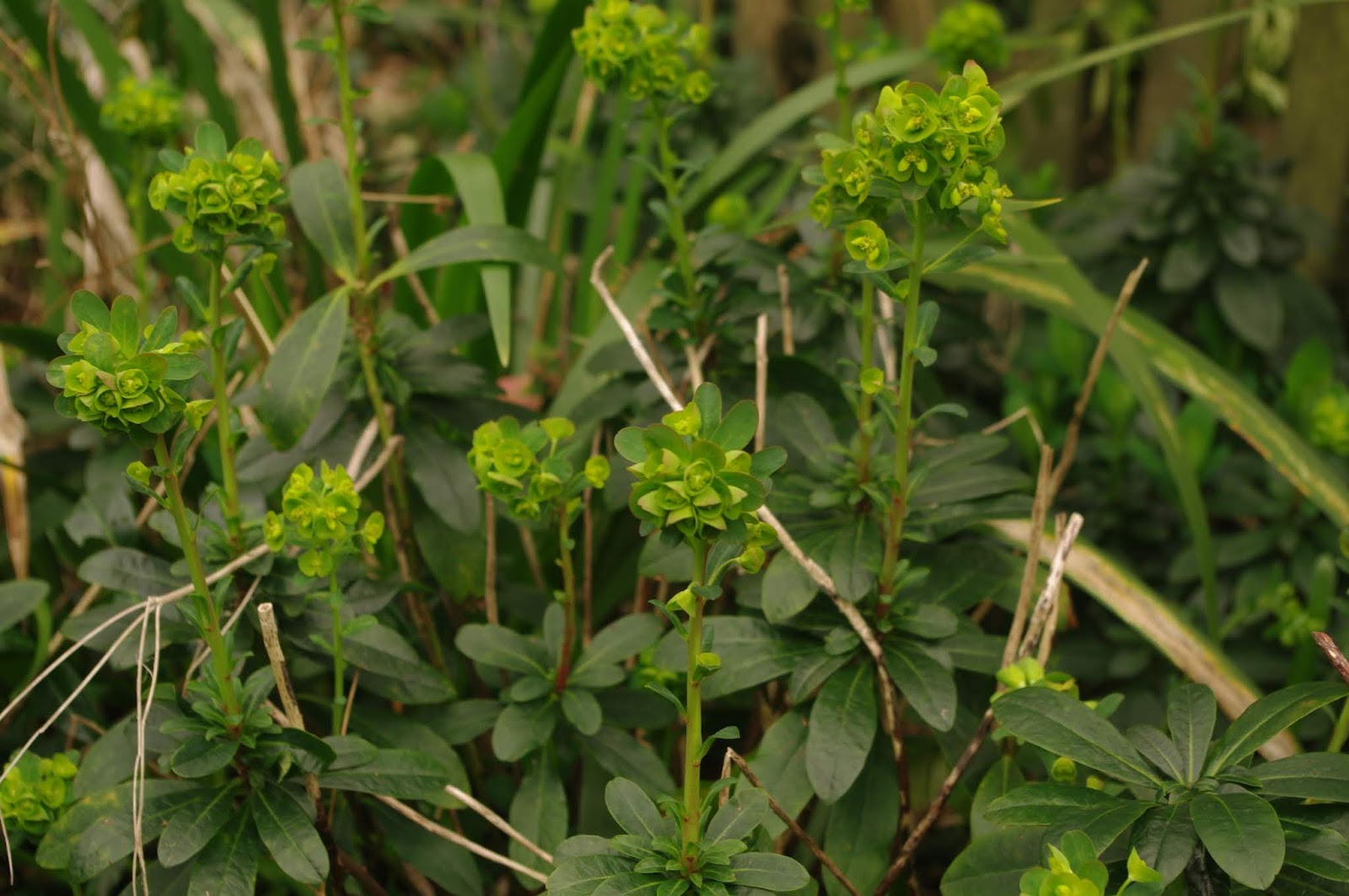
 Euphorbia amygdaloides var. robbiae is a stalwart of the dry shade garden. The ones I planted are steadily increasing and weaving through the fronds of Iris foetidissima, another robust plant for these conditions.


 I. foetidissima is sometimes called the Stinking Iris but like the Stinking Hellebore it's nothing worse than a musty smell that's detectable if you crush the foliage. The small flowers in summer are pale and delicately veined but the berries are a bright orange splash that lasts throughout winter.  

 When I began to tend this garden nearly a decade ago it was particularly dry and shady towards the back, an interesting challenge. At the end stands a large sycamore. The garden next door on the north side had a mature evergreen oak and the garden on the south side a large cherry tree. The sycamore is still there but last year the oak was felled and the cherry tree -which was ailing- came down in high winds.
 It will be interesting to see what effect this has on the existing plants and I'm intrigued to know what new ones might be able to flourish.   

Tuesday, 5 March 2019


 Wonderful weed: the Red Dead-nettle (Lamium purpureum). It appears all over the place at this time of year and keeps on flowering well into autumn. Lamium species are much frequented by bees so the long season of this one makes it an important source of nectar and pollen. It's a diminutive but prolific annual that thrives on disturbed ground be it in the town, city or countryside; the patch above is on the allotment.

Monday, 4 March 2019


 A couple of good sessions on the allotment...


 I finished mulching round the fruit bushes. My father had made a great suggestion to use the pine needles that drop copiously from a stately Scots Pine at the bottom of his garden; every year a thick new layer falls. I did some research and learned that pine mulching is common in the US (probably because they have a lot of pines!). Pine mulch may have the effect of making the soil slightly acidic over time- and fruit bushes like slightly acidic soil so it's all good.
 Then I shoveled some well rotted kitchen compost round the bushes. The soil on the allotment seems rather depleted and will benefit from extra organic matter to improve the soil structure and fertility.


 I then turned my attention to the two beds of where the raspberry canes are (or will be when they put on new growth). Having used the fresh needles on the fruit bushes I started to dig down into the spongey layers that have built up year after year beneath the pine tree. I would estimate each year adds about an inch and each layer becomes more crumbly until you reach loose friable soil five or six layers down where it begins to merge with the solid earth below.   


 It's a perfect mulching consistency and I now understand why the Americans refer to it as it pine straw mulch; it does indeed have the texture of composting straw. NB I mixed it with a bag of regular garden compost that was going spare to add a further fertility boost.
 One potential drawback of mulching is that it can provide a happy home for slugs but I don't think they'll like pine mulch, we'll see.  


All in all a job worth doing. And better still the cost in pounds, shillings and pence: zero. Carbon footprint: zero (I wheeled my wheel barrow down the streets broad and narrow, it's about a 10 minute walk from my father's to the allotment). Always very satisfying to garden on the basis that nothing is wasted.

Sunday, 3 March 2019


 One of the delights of the garden in springtime is that things pop up unexpectedly. I'd forgotten that I planted some dainty little Oxlips last year. Primula elatior is a woodland relative of the Cowslip (Primula veris). I should plant some more of them because I haven't been to able to establish any Cowslips as I hoped I might. P. veris likes a chalky soil in the open whereas P. elatior favours light shade and heavy clay so is more suited to this particular garden.
 Oxlips are rare in the wild though Cowslips can sometimes be prolific in spots where their habitat hasn't been lost to intensive farming. Both are related to the Common Primrose (Primula vulgaris) which is indeed common in town and country.  

Saturday, 2 March 2019


 London is a city full of trees. Urban it may be but the number and diversity is huge. At this time of year many London streets are lit up by the flowering of various Prunus species (including the street where I live as seen above).


 I'm sure it doesn't compare to cherry blossom time in Japan (that's something I would love to see) but it illuminates many a road/park/garden to invigorating effect. The weather was ridiculously warm and sunny this week -more like early summer than late winter- and the blossom looked even more intense than usual.


 Honey bees were out in force. A garden, park or meadow full of bee friendly plants is a good thing but a single large tree can be a massive source of pollen and nectar. London is fortunate in this regard.