A diary of back garden botany, urban ecology, rural rambles and field trips to the middle of nowhere...
Friday, 16 March 2018
Lesnes Abbey Wood is a survival of ancient landscape within the urban sprawl of south-east London. In Richard Mabey's seminal book 'Flora Britannica' it is described as "one of the nearest colonies of authentically wild flowers to London". In fact it is actually within Greater London bordered by Plumstead, Thamesmead and Erith.
The ruins of Lesnes Abbey remain and the woods rise in sloping hills above them. At this time of year they are noted for swathes of Wild Daffodils (Narcissus pseudonarcissus). It's far from the Lake District where Wordsworth saw his host of golden daffodils, but the same species.
I shall try to return sometime next week. The daffodils should still be in flower and I noticed patches of Wood Anemones (Anemone nemorosa) among them. The foliage was showing and the flowers will probably unfurl a few days from now. The combination of the creamy yellow shades of Narcissi over a haze of white Anemones could be quite something.
Thursday, 15 March 2018
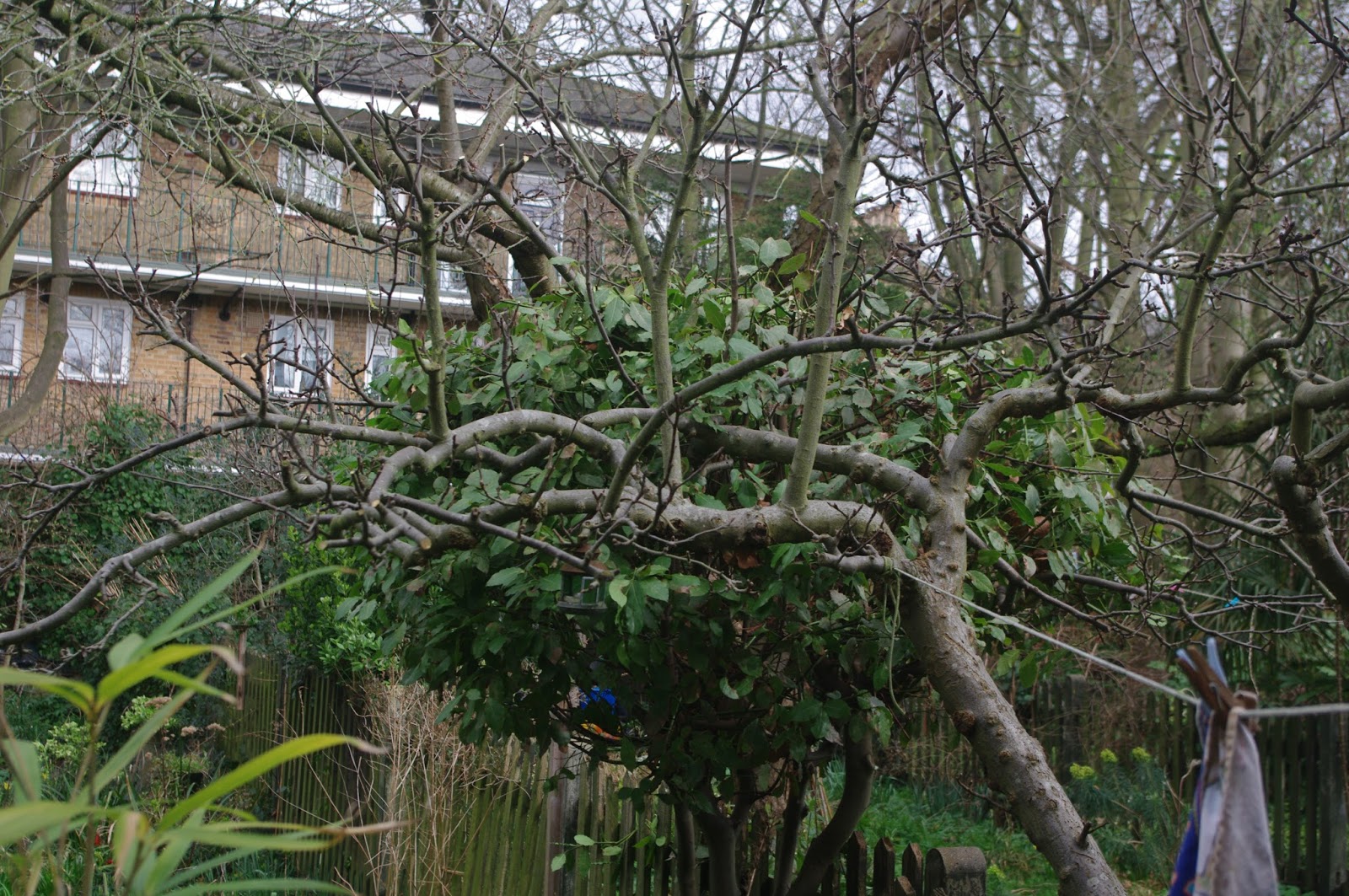
Before and after. This Bay Tree (Laurus nobilis) was getting a bit big and starting to swamp the apple tree next to it so I gave it a haircut. Bays shape well with careful pruning and frankly there's only so many Bay leaves you can use in cooking so I'd rather have the apples.
This seemed like a good time to do it. March is generally past the worst of the frosts (in London at least) and a shrub like this is still fairly dormant but about to put on a spurt of growth. I didn't want to leave it much later because there is invariably a Blackbird nesting in the heart of it from spring onwards. You would think this is a bit low to escape the attention of one of the neighbourhood's many moggies but it doesn't seem to be a problem.
The apple tree itself is a trickier proposition. A previous resident trained it but then it was left for years to grow as it liked. Now it is neither the classic 'goblet' shape favoured by apple growers nor an ornamental shape though it flowers and fruits nicely (last year produced a particularly tasty crop). I settle for opening up the branch structure where possible and giving it a somewhat bulbous shape which seems to work ok.
Wednesday, 14 March 2018
This is Narcissus Telamonius Plenus. I bought some from the specialist grower Shipton Bulbs who reckon that it is the double flowered form of the wild N. pseudonarcissus; as such it may be a cultivar but perhaps it is a naturally occurring mutation.
They note it is similar to N. Van Sion which was introduced from Holland in the 17th. century; its actual origin may well be lost in the mists of time.
Sunday, 11 March 2018
Saturday, 3 March 2018
The thaw is here -for now- and these Crocuses (C. tommasinianus) keep on keeping on. They were flowering in the lawn before the snow came, were buried underneath it for several days and now show their heads like nothing happened.
I don't usually quote myself in this diary but as I said in my entry about "Tommies" a couple of weeks ago: "They have an ethereal quality but they're tough: flowering in February they can withstand the last throes of winter".
Friday, 2 March 2018
Thursday, 1 March 2018
Appropriately this is a Spring Snowflake (Leucojum vernum) photographed at the weekend in chilly sunshine. It's probably under snow at the moment.
At first glance it could be taken for a Snowdrop, the white flowers with the green marking on the tips of the petals are very Galanthus-like. But it's taller and the yellow stamens are unlike Snowdrops. It also resembles the Summer Snowflake (Leucojum aestivum) which confusingly flowers in spring rather than summer despite its name.
L. aestivum flowers later in spring however- see my entry of 18th. April 2017 concerning its native stronghold in Berkshire where it is known locally as the Lodden Lily. Since the above specimen is in full flower as of late February I assume it is indeed L. vernum.
Subscribe to:
Posts (Atom)