A walk through Hitch Wood near Hitchin which is noted for its Bluebells (Hyacinthoides non-scripta). A shimmering haze of blue/violet in the dappled light of spring sunshine.
A diary of back garden botany, urban ecology, rural rambles and field trips to the middle of nowhere...
Saturday, 30 April 2022
Friday, 29 April 2022
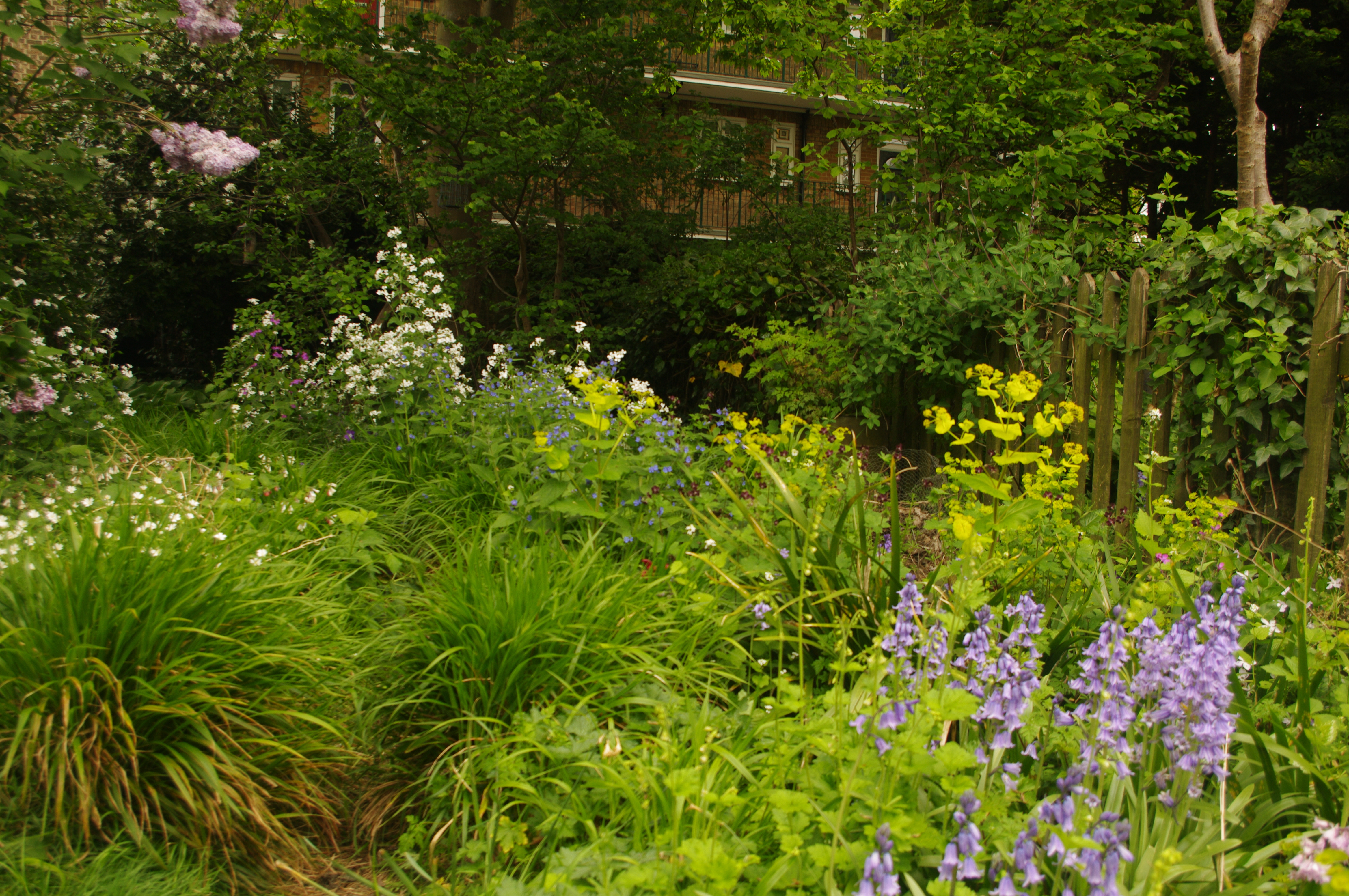
This section of the garden represents something like my ideal of a layered, successional woodland planting or more accurately edge of woodland. London gardens are often well suited to a woodland edge selection of plants. Invariably there is the shade of mature trees and surrounding buildings but also a good amount of sun for part of the day.
The meeting of open ground and forest (or glades within a forest) is a productive habitat in nature- the flora and fauna get something of the best of both worlds. So from the design point of view these are the plants to choose.
Plants that like or tolerate shade tend to flower earlier in the year to take advantage of the light before the the tree canopy leafs up. Therefore late winter to early summer is the peak flowering period though there's plenty of greenery into autumn and a few plants that will flower deeper into summer.
The trick is to select plants that come on as others fade start to fade. This is achieved by a mix of bulbs and perennials that clump or spread. Self-seeders -particularly biennials- fill any patches of bare soil. Climbers can be used to good effect if they have something to cling on to.
By careful selection different species (often from different parts of the world) intermingle and co-exist. In a sense this mimics a natural ecosystem. Nature is sometimes perceived as chaotic. In fact nature is orderly on a colossal scale. It's possible to tune in to that natural order albeit on a smaller scale in a garden.
Thursday, 28 April 2022
As bulbs go Star of Bethlehem (Ornithogalum umbellatum) doesn't seem to achieved much kudos. It grows wild in Eastern England but has been largely eradicated because it contains toxins which can affect grazing animals. Nor has it acquired any popularity among gardeners though it naturalises well in grass; perhaps it's deemed too untidy for carefully manicured lawns.
Needless to say I planted Star of Bethlehem in the garden and they do indeed shine like stars...
Wednesday, 27 April 2022
The banks of the Thames between Richmond and Twickenham are one of London's more bucolic locales. I walked along the north bank from Richmond Bridge to the riverfront at Twickenham. On the way I stopped for a pint at the White Swan which overlooks the river.
I went as far as the footbridge that leads onto Eel Pie Island then doubled back past the Swan to the foot ferry that crosses the river between Marble House and Ham House. Several generations of several families have operated a ferry here since 1908. The crossing costs a pound- good value in this day and age!
Disembarking on the south bank I cut through Petersham and across the meadows back to Richmond.
The Thames from Richmond Hill was a recurring theme in the paintings of Turner. This stretch of the river still evokes an older England but some of the flora less so; perhaps that is appropriate since it was the Thames that connected London to the world.
I saw lots of Himalayan Balsam sprouting on the banks and the marshy thickets were carpeted with Three Cornered Leek. These Giant Echiums from the Canary Isles stood tall among a mass of Green Alkanet.
I have noted before that the blue flowered Echium pininana is naturalising rapidly in London. The red flowered E. wildprettii is rarely seen but intriguingly seems to have hybridised here with pininana to produce a group of intermediate forms in hues of blue tinged with pink and pink tinged with blue...
Tuesday, 26 April 2022
Solomon's Seal, a graceful plant of woodlands and shady gardens. This one is Polygonatum multiflorum but the common name Solomon's Seal seems to be used for a good many of the sixty or so species that occur across the Northern Hemisphere.
The reference to Solomon is obscure with differing explanations. My plants were purchased from the catalogue of Shipton Bulbs who suggest that "It gained its curious name from the belief that the leaf scars on the rhizome resembled Hebrew characters".
Sunday, 24 April 2022
I don't really grow Tulips. I suppose I think of them as too cultured, not 'wild' enough but they are certainly elegant. Some pop up every year on the allotment and these two stems I placed in a vase.
In fact I do plant Tulipa sylvestris which grows wild in the UK- the only species to do so. And the Tulip meadows of Kazakhstan and the Tien Shan Mountains must be pretty wild!
Subscribe to:
Posts (Atom)